Fruitful

The Hearts of Our Shepherds

Sunday’s service at our church featured an interview with our Shepherds (elders) in place of the usual sermon.

“The Hearts of Our Shepherds,” was aimed at providing opportunity for these men to share some of the themes dominating recent meetings, along with some of the more personal desires and prayers that each of them hold for our congregation.

By all counts, it was meaningful.

The interview closed with me asking each Shepherd what we, his church family, could pray for on his behalf. These men of God offered responses like wisdom and clarity, opportunities for greater influence with non-Christian friends, renewal within our church family, and significant personal spiritual growth.

Prior to praying, one Shepherd turned the question back toward me.

What could the church that I serve pray for me?

Springboarding off of a few of the Shepherds’ ideas, I described the burden that exists within leadership. There is a pressure involved in the awareness that many look to me for direction or inspiration or steadiness. Many times, however, I aim to provide these, with less confidence than I wish in my own abilities, focus, or strength.  It feels like the job could always be done better.

Even as I spoke these words, I was seeing in the congregation educators, healthcare workers, managers, social workers, financiers, and more. I felt a measure of guilt as my eyes beheld them and my mouth shared those words, as if I were suggesting that my role of leadership was “so important” that I needed extra support to bear it, as if I faced unique challenges that require unusual backing.  No such sentiment existed within me, but something that I couldn’t identify rubbed inside me in that moment.

Reflecting later, I found myself considering my ministry role in terms of task lists and skill sets.  All those people I’d noted have their own similar loads to carry within their own roles, and they aim to possess highly developed skills and to execute their tasks with integrity and excellence that demand discipline and focus.  Of course, I regularly set myself toward such goals within my job too, but it dawned on me that this was not at the heart of my prayer request.

So what was?

Queue up our weekly Small Group.

That evening’s text for discussion was John 15:1-11. After our usual “telling of the story”, we zoomed in on the text by using JB Phillips’ paraphrase:

1-8 “I am the real vine, my Father is the vine-dresser. He removes any of my branches which are not bearing fruit and he prunes every branch that does bear fruit to increase its yield. Now, you have already been pruned by my words. You must go on growing in me and I will grow in you. For just as the branch cannot bear any fruit unless it shares the life of the vine, so you can produce nothing unless you go on growing in me. I am the vine itself, you are the branches. It is the man who shares my life and whose life I share who proves fruitful. For the plain fact is that apart from me you can do nothing at all. The man who does not share my life is like a branch that is broken off and withers away. He becomes just like the dry sticks that men pick up and use for the firewood. But if you live your life in me, and my words live in your hearts, you can ask for whatever you like and it will come true for you. This is how my Father will be glorified—in your becoming fruitful and being my disciples.

9-11 “I have loved you just as the Father has loved me. You must go on living in my love. If you keep my commandments you will live in my love just as I have kept my Father’s commandments and live in his love. I have told you this so that you can share my joy, and that your happiness may be complete.

In sharing the portions of that text that spoke most personally to us, one group member noted that the first eight verses are heavily metaphorical, except for one blatant-as-can-be line:

For the plain fact is that apart from me you can do nothing at all.

And that quick comment decoded my earlier thoughts.

In any role, there are skills to be had and honed. Effort and excellence, organization and output–these are all relevant to discussions of successful leadership and efficient productivity, and I find myself intrigued and interested by such dialog.

But in matters of lasting fruitfulness, the type which ripples through eternity, an infinitely higher concern is connection to Jesus.

Is our connection to him substantial enough that his life flows through us?

That is the only question needing an answer and the only goal requiring a pursuit.

If it is, then the possibilities for life-giving impact on our world are as vast as God Himself. Anything less shrinks life to where the best I can hope for is an appearance of success, suggested by personal pleasure perceived or social recognition received.  An anonymous quote I read said, “Without Jesus, one can be certainly be successful.  But being fruitful is another thing altogether.”

I think that is the rub I felt on Sunday, and if I could rephrase my clumsy prayer request to be more accurate, that’s what I’d say:

Pray that I so connect with Jesus that His life flows freely through me, bearing much fruit.

Amen to that.

Saturday Six-Pack (12)

Welcome to the long weekend for my Canadian readers.  To those elsewhere, yours is surely coming before long!  Either way, it’s a pleasure to have you here for a bit of “Wandering & Wondering”.

Each week, the “Saturday Six-Pack” aims to share a half-dozen of the best online pieces I’ve read recently.  The majority of links lead to faith-focused or ministry-geared material, with the rest falling under the “disorderly pile of who-knows-what” tagline at the top of this page!

For today:

1) Spirit-Filled Living vs. Just Trying Harder
If you ever have the sense that the Christian life will require more than you have to give, you may be onto something.  Jim Cymbala is on to the same thought.

2) Does Suburbia Hurt Christianity?
Numerous churches speak of the quest to “live a life together”. But what if our everyday circumstances are sabotaging that goal? Then Relevant magazine writes an article about it!

3) The Lost Sin of Envy
Tim Challies challenges us to look inside ourselves, in search of the slippery sin of envy.

4) Why Bible Study Doesn’t Transform Us
Even this post’s title is provocative to this group sure-loving fellowship in which my faith has been birthed and nurtured. How could power possibly be lacking when people interact with God’s Word? Oh, there are numerous ways.

5)  The Idolatry of Individualism
The term “idolatry” is somewhat foreign to many Christians. It connotes images of gold-covered statues and flaky figurines.  We’re not so dumb as to let such things lead us away from the Eternal One.   But what about when the term is linked to one of our culture’s highest values?  That’s a tad less comfortable.

6) You Are Not a Computer (Try as You May)
Technology is meant to serve us. Instead it increasingly runs us — and runs us down.  Tony Schwarz of HBR brings these words of balance to how to live plugged-in without being sucked dry.

Have a great weekend, friends–renew yourself and reverence God.

Hearing and Obeying

My friend Kevin leads a church plant in North Central Regina; it’s called the Gentle Road Church of Christ.  A video about this effort can be viewed HERE.

Recently, Kevin wrote up some reflections inspired by the work and writings of Lesslie Newbigin, a most interesting missionary, who lived from 1908-1998.  With permission, I’m posting Kevin’s write-up here.

If you are involved in any form of church leadership in the Western hemisphere OR you feel the struggle of living out your Christian faith in Western society, these words will likely carry substantial weight.

WARNING: OBJECTIONAL CONTENT.  This material will change your life.
 

Have you ever heard someone leading the closing prayer, pray that “we would apply what we learned today”?   Or the preacher urge us to “apply this to our lives”?

 
This language indicates a disturbing flaw in our approach to our faith.  In The Open Secret: An Introduction to the Theology of Mission, veteran missionary Lesslie Newbigin contrasts our Western world approach with other worldviews.  In the Western world, we talk about ideas and walk around them as though they are objects in a museum.  They are ideas that “free float”, concepts that we discuss, observe and analyze.  The “application of them to our lives” is a secondary step, and from the language of the preacher and the closing pray-er, they are optional.  We choose whether we will do them or not, and if we do them, how thoroughly and wholeheartedly we will do them.  
 
In Henri Nouwen’s book Spiritual Direction, he describes how his students at a prestigious university in the US enrolled in his classes to hear about his time among the poor in South America.  He had spent a couple of years living and serving among the disenfranchised in Latin America.  But his US students were mostly spectators of his journey, curious to learn about the journey, not interested in making the same journey themselves.  
 
We have the same thing in our churches.  We have Bible classes about confessing our sins to one another, humbling ourselves before God, sharing our faith with the lost, giving sacrificially, and praying.  But we don’t actually confess our sins to one another (for the most part).  We talk about it, but we don’t actually do it.  And far be it for the preacher/teacher to expect that everyone will do it.  Imagine the Bible class where the teacher reads James 5, and then says, “OK, now we are going to practice this.  We are supposed to confess our sins to one another.  What is the best way for us to do this today?”
 
Contrast this approach, says Newbigin, with the assumptions of the liberation theologians in South America.  In their worldview, there is no separation between faith and action, between ideas and justice.  People who aren’t working for justice aren’t doing anything, they are just talking.  You either actively join the cause against the totalitarian regime, or you are with it.  Newbigin goes on to critique some aspects of liberation theology, but he commends this much: that in Latin America, faith is never a spectator sport.  There is never a gap between knowledge and application.  Faith means working for justice, period.  You will never hear them pray that “we would apply what we learned today.”
 
So what does this look like in real life?  My friend Oscar Contrares grew up in El Salvador, and actively participated in the resistance movement.  He tells me that when they had Bible studies, they always ended the gatherings with a call to action.  There was always something to do, some political, economic or practical way to participate.  You never left the meeting without being shoulder-tapped to help in some way.  The call to obedience was immediate, practical and communal.
 
I believe Jesus speaks to this exact point in Luke 17.  Does the servant come in from working in the field all day and expect the master to invite him to sit down with him and feast?  No.  He prepares the meal for the master and then only after he has done all of his work, he gets to sit down and eat.  Then, “Would he thank the servant because he did what he was told to do?  So you also, when you have done everything you were told to do, should say, ‘We are unworthy servants; we have only done our duty.'”  (See Luke 17:7-10)  This is the kind of spirit that Jesus’ disciples are to have – an immediate, humble and submissive heart to the commands of the master.  There is no gap between hearing and obeying.  Whatever Jesus commands, we obey “right away, all the way, in a happy way” (stolen from a parenting mantra).  
 
One of the problems in our churches is that we do things that reinforce this gap between hearing and obeying.  Everytime we have a Bible study where we don’t call or expect people to obey immediately, we reinforce this gap.  Everytime we intellectualize or walk around a Bible study topic like a rare museum artifact, we subtly reinforce that we are passive observes and that we in control of our response.  Instead we need to abandon control of our response in advance and commit to do everything our master bids, in the spirit of Luke 17.  We need to commit to obedience before we leave the building, and at the end of it all say, “We are unworthy servants; we have only done our duty.”
 
I believe that we need new DNA in our churches.  We need to eliminate this gap between hearing and obeying, and we need leaders who are going to lead by example, who fully embrace the spirit of humility, obedience and submission to Jesus Christ as Master of all.  And we need to raise the bar in our congregations, by providing immediate and practical ways for people to obey what they hear, and actually expect people to do it.
 
There is a saying that “what we convert people with, is what we convert them to.”  If we convert people with an approach that faith is a spectator sport, we will have spectators in our pews.  If we convert people with an approach like Luke 17, I think we might have a very different reality.
 
May the gospel come to us “not simply with words, but also with power, with the Holy Spirit and with deep conviction.”  (1 Thessalonians 1:5)

Ash Wednesday

A year ago, I reflected on what I would do if I ever attended an Ash Wednesday service.  As of today, I still have yet to act on these intentions.

However, I am committing to re-entering the season of Lent, with its beginning today.  If Lent is unfamiliar to you, the following video will catch you up in a mere two minutes:

If you’re interested to push the exercise at least one more small step, you could join me in forty days of devotional readings from an Ignatian group of bloggers.  I’ve bookmarked THIS site as a few moments of ritual over the coming weeks.  I’d love to have you travel with me.

How about you?

What does Lent mean in your life?  How do you plan to mark it this season?

Please nudge me and others along by leaving your comments below.

Blessings on you in this season of repentance and renewal, as we taste of the wilderness.

Valuing Scripture

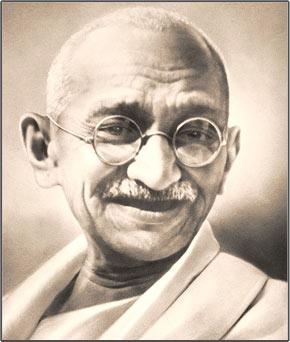
Gandhi has always inspired me.  Often the inspiration comes in the form of a knock right between the eyes.

Like this one…

“You Christians look after a document containing enough dynamite to blow all civilization to pieces, turn the world upside-down, and bring peace to a battle-torn planet.  But you treat it as though it is nothing more than a piece of good literature.”

I don’t know what to say after that, so I’ll just leave it hanging there for you.