Hell: A Reality Worse than the Imagery

love-wins-setThe topic of hell has received an unusual amount of attention in Western theological discussion over the past decade.  Of course, the most popular strand of this discussion centered around Rob Bell’s book “Love Wins”, with denser strands weaving through the academic realms of publication and discussion.

Much of the conversation is built around distaste for the concept of never-ending punishment, particularly as it is wrapped in imagery of fire and burning.  This leads to several valid questions:

  • What depiction of hell is truly biblical, and what has been developed through the art and literature of the ages?
  • How literally or metaphorically are we to take what Scripture does tell of the final judgment?
  • What do biblical words like “Gehenna” really mean?

These are just a sampling of the sub-topics that factor into the larger discussion of “What do you make of the concept of hell?”  Certainly, this discussion matters; to some, it appears to matter immensely.

I am not among that number.

Part of that is due to the following quote from Timothy Keller:keller3

“To say that Scripture’s image of hellfire isn’t wholly literal is no comfort whatsoever—the reality will be far worse than the image.”

We can hardly be blamed for our flesh-fettered views. Nerves and neurons, skin and sensation, these are the means by which we experience our world. And in that light, it is easy to see why heaven’s depiction is golden and lavish, while hell’s is dark and despairing.

But what if our senses misguide us?

sensesWhat if the imagery–as vivid as imagery and language can formulate–fails to capture the intensity?

What if the most intense scenes of suffering that a human imagination can generate are pitifully poor metaphors for communicating the reality of a creature cut off from its Creator?

It seems easy to convince people that heaven will actually surpass an experience revolving around golden streets and massive mansions.  We recognize that the extravagant physical depictions fail to express even a sliver of the spiritual reality. We acknowledge that the core of that experience will center upon the overwhelming and unmissable presence of God and upon the river of life-to-the-full that will flood-flow from Him to His companions.

Humanity’s heaven imagery is pale and poor to communicate the intensity of the reality.

Yet seldom is an equivalent argument applied to hell.  And if the case is made, then it’s made only halfway.  It is one step to recognize the limitations of imagery and vocabulary.  One can say that without saying much.

But it is a big-as-a-beast statement to suggest that the imagery of hell, the metaphors that make us squirm, even buck against the entire concept, are actually too weak to communicate the magnitude of the reality.

If heaven is actually better than jewel-encrusted architecture, then the counter-statement stands too.

Hell is worse than burning.

C.s.lewis3C.S. Lewis used to speak of “the unsmiling concentration upon Self, which is the mark of hell.”  Unchecked and freely reigning within a life, self-centeredness consumes in ways sparks never will.  It scars the soul and warps one’s world.  And it appears that anyone who desires this path can have it. So powerfully are we created that our choices in the present life ripple through eternity.

But we’d be wise to make our choices, aware that the imagery is not nearly so fierce as the reality.

Hell is worse than burning.

YOUR TURN: How do you handle the Bible’s imagery of the afterlife, in light of the thought that the imagery is actually light-weight when compared to the reality?

Become part of the conversation. Your voice makes this post better.

[You can subscribe to this blog via RSS or email, in the upper right corner of this page. As well, follow me on Twitter ( @JasonBandura ) for 3-4 daily tweets daily of of insightful quotes or intriguing articles, sprinkled with occasional goofiness.]

The Giver of Joy

The 2013 Advent Blog that my church is hosting continues to run.  Here was my recent post on the topic of JOY:

[ABOUT THE AUTHOR: Jason Bandura works with the Glen Elm Church of  Christ.  Married to Shannon, he is Dad to three lovely daughters.  He lives on the Canadian prairies and writes occasionally HERE.]

Is this an early Christian mission OR one of pop music’s teen idols battling for survival?

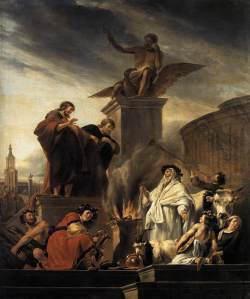
fansIn Acts 14, Paul and Barnabas have to fight off adoring fans. While preaching the Gospel with the city of Lystra, they healed a local cripple, sending the crowd into bedlam. The whispers-turned-to-shouts begin to revolve around a theory that the two missionaries are actually Zeus and Hermes mingling among humanity.

Paul and Barnabas were having none of it:

14 But when the apostles Barnabas and Paul heard of this, they tore their clothes and rushed out into the crowd, shouting: 15 “Men, why are you doing this? We too are only men, human like you. We are bringing you good news, telling you to turn from these worthless things to the living God, who made heaven and earth and sea and everything in them. 16 In the past, he let all nations go their own way. 17 Yet he has not left himself without testimony: He has shown kindness by giving you rain from heaven and crops in their seasons; he provides you with plenty of food and fills your hearts with joy.”

That last sentence recently grabbed my Advent-tuned mind.

Paul_and_Barnabas_at_Lystra_-_1650Paul and Barnabas credited God as the Maker and Manager of all things, who refuses to micromanage. Instead, they observed this Overseer allowing for freedom, while providing low-key, you-will-need-to-listen-carefully testimony of His constant presence.

According to non-Zeus and non-Hermes, one of the things that argues for God is joy.

This intrigues.

One of the classic lines of doubt in God’s existence springs from a simple theory: If evil is in the world, surely God is not.  The question here connects with every heart that has hurt. In times of pain, it springs so quickly that one has no chance to even assess its substance on its way out.

In the struggle to believe in a God who hasn’t already obliterated evil, some turn to a worldview that involves no deity at all.  We were not created; we evolved. There is no Plan; just the ones we make. Life, by its nature, is utilitarian. The strong (ie: useful, functional, advantageous) survive, whether you speak of traits or ideas or people.  To observe Darwin’s theory in moths changing colour is one thing; to extend his thoughts into an overarching interpretation of reality is another.

This is where one consideration demands more attention: What to do with fun? Beauty? Pleasure?

In a world void of any good and gracious Provider, in a world governed by “the strong survive”, how does one interpret joy?

In matters of God, airtight argument is like the Holy Grail. It’s longed-for, but the longer you seek it, the less you believe it exists. Knowledge of spiritual things requires a different processor than mere reasoning, much to my logic-loving chagrin. Gratefully, I have been kindly chided into confession that it is a very good thing that there is more going on than I can grasp.

In a world that I could entirely understand, nonsense like joy would have no place.

Loose ThreadNineteen centuries ago, Paul and Barnabas contended that joy was a loose strand, begging to be tugged on.

Give it a pull.

If you do, it will pull back.

When Your Doing is Your Undoing

This beloved portion of Scripture was part of this morning’s reading (1 Peter 1:3-4) :

3 His divine power has granted to us all things that pertain to life and godliness, through the knowledge of him who called us to his own glory and excellence, 4 by which he has granted to us his precious and very great promises, so that through them you may become partakers of the divine nature, having escaped from the corruption that is in the world because of sinful desire.

Many will tune out after the first major phrase: God gives us all we need.  Within itself, that is a wonderful truth, capable of fostering trust in God as the kind and capable Provider of all, to all.

However, Peter’s line of teaching goes a fair bit further.

Not only is God committed to providing life’s needs.  He is committed to making provision for each of us to journey into godliness, the state of God-likeness for which every human being has been designed.  To approach God is to open the door for Him to give you what you need for an existence of “glory and excellence”, even before we have any aspirations or desires for such a life.

The heavyweight phrase in this passage is undoubtedly “partakers of the divine nature”.  One could muse endlessly over the implications of such a five-word package.  But at least two points are clear:

  1. God has made outrageous promises that He intends to keep.
  2. These promises center upon delivering people into this form of existence: Partakers of the divine nature.

Then, in a clarifying statement, Peter expresses that one mark of this type of life is an escape from the corruption caused by sinful desires.  This corruption is in our world because it is in our hearts, and it is God’s intention on neither public nor private scales.  The one who knows anything about God will know this, and the one who values anything about God will make every move they can think of, in that direction.  This is where Peter’s list (faith, virtue, knowledge, self-control, steadfastness, godliness, brotherly affection, and love) finds its spot within the text: Pursue these qualities in your quest to experience both freedom and fruitfulness in Jesus Christ.

Efforts aside (and there are many to make), this escape from the dark and distorting desires of our hearts unfolds only as we:

  1. Embrace the promises of God (most call this “faith”).
  2. Seek to partake in the divine nature.

This second line matters greatly, as it speaks to the motivation behind every move we make.  Minus this motivation, we fall back into lesser motivations that actually undercut the transformation process:

  • Satisfaction in self, based upon some unwritten scoring system.
  • Reputation based on others’ perceptions of us or on inner illusions of ourselves.

Both of these can motivate us, but neither of them have anything to do with being freed from tainted desires.  In truth, both of them actually feed the corrupt (ie: Self-centered) tendencies that so easily sabotage our escape route into the God-designed life of “glory and excellence”.

“Make every effort”, to be sure.  But make them with measured focus, or our doing will actually be our undoing.

Grace is What Works

There is a pragmatist within each of us.

Bent toward the rational and the results,this inner dweller unintentionally opposes some of God’s most profound movements in our lives.

This logic-loving, get-the-job done approach to life, a staple of the Western society in which I’ve grown up, struggles to grasp the life-Creator, who strangely–yet frequently–insists on operating in “obviously” impractical ways.

Grace is the finest of examples.

The careful reader of the New Testament will quickly observe the inadequacy of human efforts toward salvation. However, that doesn’t stop us from trying! Bent on saving ourselves, proving ourselves, and sustaining ourselves, responsibility and duty–praiseworthy qualities within themselves–kick into hyper-gear.  In the process, pride awakens and pressure builds, all the while we are unaware that we are building brick walls between God’s salvation and our souls.

Legalistic tendencies seem wired into the human hardware.

The hymn-writer called grace “amazing”. We call it “unbelievable”. We may never use the word, but we feel incapable of grasping the concept, and embracing it feels even less likely.  That is the pragmatist within us, speaking with conviction: “Grace is impractical.”  You hear it in the push back we feel obliged to offer against grace, particularly religious or responsible citizens: “What about discipline? Grace alone is too soft; it won’t take people where they need to be. It takes more than grace to transform a life.”

Grace is not practical enough for our liking.

Or perhaps we are not nearly practical enough.

The dynamic at work here is something like John Piper describes in “Desiring God”, a book carrying the subtitle of “Meditations of a Christian Hedonist”. Piper argues that hedonism, the pursuit of pleasure, is an attitude built into the very human nature. Other than spiraling our souls into self-destruction, this pleasure-seeking drive is what drives the soul toward God.  Paradoxically, Piper suggests that the reason we get lost along the way is that we are not nearly hedonistic enough!  Settling for watered down forms of satisfaction, our pursuit of pleasure is revealed as too weak, rather than too strong. We chase happiness like slackers, at the expense of our souls.

C.S. Lewis was developing the same thought when he famously observed:

“It would seem that Our Lord finds our desires not too strong, but too weak. We are half-hearted creatures, fooling about with drink and sex and ambition when infinite joy is offered us, like an ignorant child who wants to go on making mud pies in a slum because he cannot imagine what is meant by the offer of a holiday at the sea. We are far too easily pleased.”

So back to where we began: We resist grace because it seems out-of-touch. “This won’t work in real life,” we critique.  Even more common might be the unspoken thought that Christ’s role in our lives is to provide a much-needed “reset” button. By his death and resurrection, he presses it and we sigh with relief.  We can take another kick at getting things right, in practical and reasonable ways, of course, powered by the fuel of self.

In this sense, we are part of a rich heritage of Christians who don’t get it.  Paul’s question to such folks:

Who has cast an evil spell on you? For the meaning of Jesus Christ’s death was made as clear to you as if you had seen a picture of his death on the cross. 2 Let me ask you this one question: Did you receive the Holy Spirit by obeying the law of Moses? Of course not! You received the Spirit because you believed the message you heard about Christ. 3 How foolish can you be? After starting your Christian lives in the Spirit, why are you now trying to become perfect by your own human effort? (Gal.3:1-3)

Beyond the Galatian goofballs, is anyone else’s “reset” button worn out from use?

“Seeking free-flowing forgiveness so we can take another futile kick at life on our terms”: Give me Impractical for $1000, Alex.

And there’s the rub.

Grace, in all its mystery and apparent irrationality, is the most practical of solutions to the human predicament.  The God we dismiss as idealistic or illogical actually, shock of shockers, knows what He’s doing, with His “power move” of offering freedom through surrender and victory through defeat.  Much to our surprise, perhaps chagrin, grace works.

In fact, it is only grace that works.

YOUR TURN: Why does humanity buck so hard against God’s grace?  What do you grasp about grace today that God has faithfully taught you over time?

Please leave your comment below, and enter the conversation.

[You can subscribe to this blog via RSS or email, in the upper right corner of this page. As well, follow me on Twitter ( @JasonBandura ) for 3-4 daily tweets daily of of insightful quotes or intriguing articles, sprinkled with occasional goofiness.]
Escaping Aggravation

What do you find aggravating?

For many, the myth of Sisyphus captures the essence of frustration. Sentenced to roll an immense boulder to the crest of a hill, he looked on helplessly as the task was reset over and over again.

Within Scripture, the imagery of frustration, frequently portrayed by the Old Testament prophets, involves fields and vineyards that will be laboriously watered with one’s sweat, only to see the fruit harvested by conquering enemies.

The book of Ecclesiastes opens with eleven verses of 360-degree madness: Circles upon circle upon circles:

  • Generations passing.
  • Sun rising and setting.
  • Winds blowing.
  • Seas filling and emptying.
  • Desires motivating and remaining.
  • Ingenuity creating and re-creating.

Solomon, the king of wisdom, makes an observation (1:14) that is equal parts of sour reflection and sober recognition: We are all belted to a merry-go-round. And minus some serious center of orientation, vanity spins on the horse beside us.

Said another way, we are all within inches of living very frustrated lives, existing in ways that feel akin to “chasing the wind”.  This is a path all-too-easily found.

This is why Ecclesiastes often seems so depressing, because here we have Solomon, gifted more wisdom and wealth, power and pleasure than perhaps any other man or woman in history, and HE (of all people) speaks fluently of the vanity of life.

But the careful reader of Ecclesiastes must not miss verses like Ecclesiastes 2:26:

“For to the one who pleases Him, God has given wisdom and knowledge and joy, but to the sinner, he has given the business of gathering and collecting, only to give to one who pleases God.”

The statement is not that life must be frustrating.  The statement is that life will be frustrating, to the extent that our goals and motivations are self-centered.  To the one bent on pleasing God, a path radically different from “vanity” opens itself wide.  It is a path where genuinely impacting learning takes place and where profound joy is tasted.

And it is a path readied for those eager to cast down self-imaged idols, in exchange for an existence centered around living out our parts as people bearing the Divine image.

And that is the opposite of vanity in every way.