Worry Results from Allowing Fear to Imagine the Invisible

worryWe all know there’s no value in worrying.

If a parent or teacher failed to personally tell us, voices throughout history are eager to chime in:

“Worry is interest paid on trouble before it comes due.” (William Ralph Inge)

“Worry does not empty tomorrow of its sorrow. It empties today of its strength.” (Corrie ten Boom)

“Pray, and let God worry.” (Martin Luther)

“There is nothing that wastes the body like worry, and one who has any faith in God should be ashamed to worry about anything whatsoever.” (Mahatma Gandhi)

Yet for all the persuasive voices speaking all the compelling words, worry takes hold on our souls.  What counter-move might we make against its persistent grip?

Charles Swindoll has offered this perspective:

“On the day Jesus was crucified, it would have appeared to anyone seeing through eyes of flesh that the darkness, the devil, and death had defeated the Son of God once and for all. I will admit that those three D’s lie at the root of almost every worry I suffer. I worry about DEATH – in particular, the death of the people I love. I worry about DARKNESS, both literal and figurative. I worry about what the DEVIL is up to. All three worked diligently throughout the ministry of Jesus to bring about this long and anguishing day. But what no one could see was that the Messiah’s death would strike at the very heart of evil.”

Worry results from allowing fear to imagine the invisible.

To be sure, there will always be an invisible realms–questions without answers, ventures without guarantees. Life, by its nature, is filled with blanks.

But the message of Scripture is that much of that space is filled by a God whose very nature is gracious and compassionate, slow to become angry and abounding in steadfast love.  Seen most vividly in Jesus’ death and resurrection, we are dared to rein in our ability to quickly imagine the worst, in exchange for a freedom to steadily believe the best.

The Bible’s opening scene depicts a God of light that dwells in the darkness and a God of order than hovers over the chaos.  As Swindoll said above, these lessons were re-affirmed for all time in what we thought were the darkest moments of all.

As God says numerous times in Scripture, “Do not be afraid, for I am with you.”

And He is.

Even more than you would believe!

YOUR TURN: How do you handle fear?  In what ways has your faith impacted your tendencies toward worry?  YOUR COMMENTS MAKE THIS POST BETTER.

[You can subscribe to this blog via RSS or email, in the upper right corner of this page.]

A Year in the Scriptures

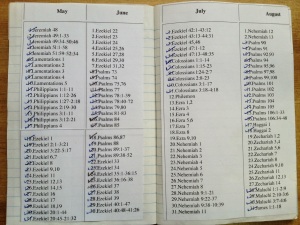
A year ago, I got myself organized by formatting our church’s Scripture reading schedule to fit neatly in my Bible cover. Below are three photos chronicling my success (and other things) in this venture:
20130101-094746.jpg

2012 Reading Schedule - Pic 22012 Reading Schedule - Pic 3A few observations may resonate with anyone who has ever tried to firmly establish a good habit:

1) Starting strong is admirable, but the real learning will take place miles from the gate you so eagerly burst forth from.

2) Life’s circumstances must be factored in. The birth of our third child, on May 28, and the rhythmic irregularities of summertime both had an obvious impact on my devotional habits.  “Creatures of habit” is sometimes tossed around as a derogatory term, but I view it as fact to be utilized wisely.  Craft the rhythms on which to build the habits, and you shape the creature you become. Do this wisely, but allow enough grace that you don’t despair when life’s special circumstances “interrupt”.

3) Reassessment and readjustment are key to ongoing success. Mid-November marked a conversation with my wife, in which we collectively planned how we desired to improve the scheduling patterns of our family life. The impact of those adjustments is obvious over the last six weeks of the calendar.

For any Christian – regardless of gender, age, or experience –  some form of Scripture diet is essential. I have never yet heard of a substantial spiritual life being cultivated apart from a love of Scripture.

A recent article by the Gospel Coalition offers five highly focused and practical tips toward developing one’s devotional habits.  If you have yet to settle upon a reading plan, do yourself a huge favour and choose one.  Numerous options can be found HERE or HERE.As well, you can view the Three Year Bible Reading Plan that our church uses. (We are just now entering year two of the cycle.)

If this habit is already well-established in your life, then you need little convincing to continue. If this habit is not yet established in your life, then today, this year, our gifts to you as entry points to the deeper realms of life available to all who seek God with all their hearts.

YOUR TURN: What have you discovered in your efforts to create Scripture and prayer rhythms in your life?  Any tips on what to do OR what not to do? Your input makes this post better!

[You can subscribe to this blog via RSS or email, in the upper right corner of this page.]
“Dad, What’s a Funeral?”

funeral flowersA few Sundays back, I was upgrading my wardrobe from the shirt and pants that I had worn to morning service to a full-blown suit and tie for an afternoon funeral. My four-year-old asked me why I was dressing up. I told her that I was going to a funeral, and in vintage four-year-old fashion, she asked the perfect question…

“Dad, what’s the funeral?”

Is it wrong that I wanted to provide her with a definition that made no mention of death, for fear of not knowing how to answer the next inevitable question?

Thoughts around mortality have rolled through my head more lately than usual.  Some of it is involvement in recent funerals. Some of it is the experience of raising small children and noting how very quickly time seems to pass.  The math doesn’t lie, nor do my joints.  Time is marching on.

Andrew Peterson, on his fantastic new album, says it this way:

And we just can’t get used to being here,
Where the ticking clock is loud and clear,
Children of eternity,
On the run from entropy.

Whatever the specifics, a couple observations linger:

1) Dust to dust is indeed the human reality, and my someday-dust-but-not-yet mind can hardly fathom the concept.  How can it be that friends I enjoyed only weeks ago can no longer exist in the form which I always enjoyed them?  We spoke and laughed and hugged, yet today, all physical traces of that speaking mouth, laughing voice, and embracing frame have vanished.  And my head shakes.

2) My struggle to grasp our own ends pushes me to consider the greater mystery of God’s endlessness.  The Bible portrays the reality that the my bookends of birth and death are merely tiny points upon the infinite shelf of God. Before me and after me, He is the sea in which my life floats.  As Scripture describes it, He goes before me and follows behind me, all the while His hand is upon me.

At times, the sting of death can seem very real.  It cuts through any veneer we have layered on.  It can unnerve us, even undo us.  Andrew Peterson’s lyrics above are affirmed as true: We do not know what to do with death, so much so that one wonders if our original design truly included this wretched feature.

pauseBut as we know, loss feels plenty real.  Sorrow can strike with staggering force.  There is no evading this enemy.  That said, perishing carries a unique perk.  This is why a friend of mine calls death “the great interrupter”.  Nothing hits the pause button as forcefully as death.  Assessments occur; inventory is taken.

In those painfully still moments, sometimes we step back from the canvas just enough to observe the frame on the painting.  And it is then that we observe that life–even in its dust-to-dust nature–is encompassed by One larger than the cosmos.

Surrounded by such loving grandeur, one can indeed walk through the valley of the shadow of death without fear.

YOUR TURN: How have/would you handle discussing death with kids? What have you learned from your run-ins with mortality? Your input makes this post better!

[You can subscribe to this blog via RSS or email, in the upper right corner of this page.]

Hell: A Reality Worse than the Imagery

love-wins-setThe topic of hell has received an unusual amount of attention in Western theological discussion over the past decade.  Of course, the most popular strand of this discussion centered around Rob Bell’s book “Love Wins”, with denser strands weaving through the academic realms of publication and discussion.

Much of the conversation is built around distaste for the concept of never-ending punishment, particularly as it is wrapped in imagery of fire and burning.  This leads to several valid questions:

  • What depiction of hell is truly biblical, and what has been developed through the art and literature of the ages?
  • How literally or metaphorically are we to take what Scripture does tell of the final judgment?
  • What do biblical words like “Gehenna” really mean?

These are just a sampling of the sub-topics that factor into the larger discussion of “What do you make of the concept of hell?”  Certainly, this discussion matters; to some, it appears to matter immensely.

I am not among that number.

Part of that is due to the following quote from Timothy Keller:keller3

“To say that Scripture’s image of hellfire isn’t wholly literal is no comfort whatsoever—the reality will be far worse than the image.”

We can hardly be blamed for our flesh-fettered views. Nerves and neurons, skin and sensation, these are the means by which we experience our world. And in that light, it is easy to see why heaven’s depiction is golden and lavish, while hell’s is dark and despairing.

But what if our senses misguide us?

sensesWhat if the imagery–as vivid as imagery and language can formulate–fails to capture the intensity?

What if the most intense scenes of suffering that a human imagination can generate are pitifully poor metaphors for communicating the reality of a creature cut off from its Creator?

It seems easy to convince people that heaven will actually surpass an experience revolving around golden streets and massive mansions.  We recognize that the extravagant physical depictions fail to express even a sliver of the spiritual reality. We acknowledge that the core of that experience will center upon the overwhelming and unmissable presence of God and upon the river of life-to-the-full that will flood-flow from Him to His companions.

Humanity’s heaven imagery is pale and poor to communicate the intensity of the reality.

Yet seldom is an equivalent argument applied to hell.  And if the case is made, then it’s made only halfway.  It is one step to recognize the limitations of imagery and vocabulary.  One can say that without saying much.

But it is a big-as-a-beast statement to suggest that the imagery of hell, the metaphors that make us squirm, even buck against the entire concept, are actually too weak to communicate the magnitude of the reality.

If heaven is actually better than jewel-encrusted architecture, then the counter-statement stands too.

Hell is worse than burning.

C.s.lewis3C.S. Lewis used to speak of “the unsmiling concentration upon Self, which is the mark of hell.”  Unchecked and freely reigning within a life, self-centeredness consumes in ways sparks never will.  It scars the soul and warps one’s world.  And it appears that anyone who desires this path can have it. So powerfully are we created that our choices in the present life ripple through eternity.

But we’d be wise to make our choices, aware that the imagery is not nearly so fierce as the reality.

Hell is worse than burning.

YOUR TURN: How do you handle the Bible’s imagery of the afterlife, in light of the thought that the imagery is actually light-weight when compared to the reality?

Become part of the conversation. Your voice makes this post better.

[You can subscribe to this blog via RSS or email, in the upper right corner of this page. As well, follow me on Twitter ( @JasonBandura ) for 3-4 daily tweets daily of of insightful quotes or intriguing articles, sprinkled with occasional goofiness.]

Saturday Six-Pack (20)

Back from a two-month absence, I have a stash of articles waiting for their spots in the Saturday Six-Pack.  Let’s get rolling!

As per usual, this weekend’s Six-Pack features a half-dozen online offerings that I recently enjoyed.  These articles are mostly faith-focused or ministry-geared, with a bit of disorderly-pile-of-who-knows-what tossed in!

If you need help starting, begin with my two *Picks of the Week*, and move from there.

For a more steady stream of such links, follow me on Twitter ( @JasonBandura ) to the right of this post.  Sharp quotes and enriching articles are tweeted 3-4 times daily.

Today’s edition:

1) 6 Reasons Why Mormons Are Beating Evangelicals in Church Growth
With the presence of Mitt Romney in the recent American election, Mormonism received even more media attention than usual.  David French, for the Gospel Coalition, offers this concise take on why the Mormon Church is “outdrawing” the Evangelical Church these days AND what we can learn from this.

2) Ranting is Not Preaching
The title says it all, but Tony Merida spends a few more lines fleshing out the temptation toward this lesser form of communication and the very real dangers that arise when pastors give in.

3) 10 Proven Practices for More Productive Leadership
In this guest post on Michael Hyatt’s blog, JD Meier offers a sharp list of practices relevant for every leader.  From his role at Microsoft to whatever role you fill, something (or likely SEVERAL somethings) from this list will speak to your current leadership challenges.

4) Lost in Translation (*PICK OF THE WEEK*)
For Relevant magazine, Berlin’s Ben Stevens ponders why so few Christians, particularly those who tie great importance to the Bible’s authority, have ever considered learning Greek. His observations may surprise you.

5) Does Quantum Physics Make It Easier to Believe in God?
(*PICK OF THE WEEK*)

One more entry from TGC, this post summarizes a larger article posted at Big Questions Online by Stephen M. Barr, a professor of physics at the University of Delaware who specializes in theoretical particle physics.  To consider how cutting edge science intersects cutting edge theology, start here today. You’ll be glad you did.

6) Seven Habits of Highly Prolific Writers
This brief piece by Henri Junttila will inspire those of you thinking about putting words on paper to but your butt on the chair and get ‘er done!  If the thought of writing appeals to you, this post will nudge you toward the reality of it.

It’s good to be back, my friends!  Enjoy your weekend through renewing yourself and reverencing God.