Jesus Wants to Heal You… Sort Of

I’ve been immersed in the gospel of Mark for months now. Recently, something from chapter five struck me with unusual weight.

Here’s the story from Mark 5:21-34:

21 And when Jesus had crossed again in the boat to the other side, a great crowd gathered about him, and he was beside the sea. 22 Then came one of the rulers of the synagogue, Jairus by name, and seeing him, he fell at his feet 23 and implored him earnestly, saying, “My little daughter is at the point of death. Come and lay your hands on her, so that she may be made well and live.” 24 And he went with him.

And a great crowd followed him and thronged about him. 25 And there was a woman who had had a discharge of blood for twelve years, 26 and who had suffered much under many physicians, and had spent all that she had, and was no better but rather grew worse. 27 She had heard the reports about Jesus and came up behind him in the crowd and touched his garment. 28 For she said, “If I touch even his garments, I will be made well.” 29 And immediately the flow of blood dried up, and she felt in her body that she was healed of her disease. 30 And Jesus, perceiving in himself that power had gone out from him, immediately turned about in the crowd and said, “Who touched my garments?” 31 And his disciples said to him, “You see the crowd pressing around you, and yet you say, ‘Who touched me?’” 32 And he looked around to see who had done it. 33 But the woman, knowing what had happened to her, came in fear and trembling and fell down before him and told him the whole truth. 34 And he said to her, “Daughter, your faith has made you well; go in peace, and be healed of your disease.”

One sharp thrust here:

There is something we want, and there is something Jesus wants. And they are not typically the same.

Allow me to decode. Continue reading

Miserere Mei, Deus

The above title is Latin for “Have mercy on me, O God,” a phrase from Psalm 51.

It is also the title of a stunningly beautiful piece of music composed by Gregorio Allegri sometime around the 1630’s.  It was intended for exclusive use in the Sistine Chapel during the morning services of Holy Week.  These services typically began around 3:00 AM, and during the rituals, candles would be extinguished until only one remained.

At some point, it became forbidden to transcribe this music and was allowed to be performed only at the services described above, adding to the mystery surrounding it.  However, in 1770, a fourteen-year-old Mozart was visiting Rome.  Hearing the piece for the first time during the Wednesday morning service, he left the chapel to write it down from memory.  It is said that he returned on Friday for a second listen to make some minor revisions.  He published the piece a year later, effectively ending the “ban” and earning him surprising praise from the Pope, who was understandably astounded at the musical genius before him.

When your schedule today will fifteen minutes of listening, press “play” on the video below and be blessed by this once mysterious, ever-majestic creation, dedicated to the Creator and Redeemer of all.


Saturday Six-Pack (1)

Welcome to the weekend, and thanks for spending some time “Wandering & Wondering”.

This is the inaugural “Saturday Six-Pack” post, an effort to share some of the best things I’ve read online from the past week or so.  Typically, these articles will be faith-focused or ministry-geared, but I reserve the right to live up to the “disorderly pile of who-knows-what” tagline at the top of this page!

In this edition:

1) Destruction: God’s Alien Work
Lisa Dye contributes this Lent devotional, focusing on the wrecking role of God’s work in our lives at times.  Creator?  Certainly.  Provider?  Sure.  Demolition foreman?  Sometimes.

2) Nostalgia: The Enemy of Faith
It’s one thing to value our past, in which we idealize memories and idolize heroes.  But Collin Hansen pushes us to take another look for the warts.  As an example, he provides this look at two recently released books, among the first scholarly treatments of great 20th-century evangelical leaders John Stott and Martyn Lloyd-Jones, wildly inspiring while being as imperfect as any of us.

3) The Intolerance of Tolerance
Is the tolerance that our society so values all that it’s cracked up to be?  Don Carson doesn’t think so.

4) How Do You Disciple New Believers?
For all the things involved in helping new Christians grow, Justin Buzzard says that we must get this part clear: “Discipleship is truth transferred through relationship.”

5) The State of the Church in Canada
The Gospel Coalition is holding a Canada Conference on this topic in late May.  While the event is being held nowhere near my home, this post contains information that will interest anyone working or worshiping in Canadian churches.

6) What People Gave Up for Lent 2012
Christianity Today offers this intriguing peek into this year’s Lent-related habits of Christians through some serious Twitter observation.  Somewhat serious, somewhat sarcastic, this short piece will cause a few smiles and a few shocks.

Have a great weekend, friends–renew yourself and reverence God.

Hearing and Obeying

My friend Kevin leads a church plant in North Central Regina; it’s called the Gentle Road Church of Christ.  A video about this effort can be viewed HERE.

Recently, Kevin wrote up some reflections inspired by the work and writings of Lesslie Newbigin, a most interesting missionary, who lived from 1908-1998.  With permission, I’m posting Kevin’s write-up here.

If you are involved in any form of church leadership in the Western hemisphere OR you feel the struggle of living out your Christian faith in Western society, these words will likely carry substantial weight.

WARNING: OBJECTIONAL CONTENT.  This material will change your life.
 

Have you ever heard someone leading the closing prayer, pray that “we would apply what we learned today”?   Or the preacher urge us to “apply this to our lives”?

 
This language indicates a disturbing flaw in our approach to our faith.  In The Open Secret: An Introduction to the Theology of Mission, veteran missionary Lesslie Newbigin contrasts our Western world approach with other worldviews.  In the Western world, we talk about ideas and walk around them as though they are objects in a museum.  They are ideas that “free float”, concepts that we discuss, observe and analyze.  The “application of them to our lives” is a secondary step, and from the language of the preacher and the closing pray-er, they are optional.  We choose whether we will do them or not, and if we do them, how thoroughly and wholeheartedly we will do them.  
 
In Henri Nouwen’s book Spiritual Direction, he describes how his students at a prestigious university in the US enrolled in his classes to hear about his time among the poor in South America.  He had spent a couple of years living and serving among the disenfranchised in Latin America.  But his US students were mostly spectators of his journey, curious to learn about the journey, not interested in making the same journey themselves.  
 
We have the same thing in our churches.  We have Bible classes about confessing our sins to one another, humbling ourselves before God, sharing our faith with the lost, giving sacrificially, and praying.  But we don’t actually confess our sins to one another (for the most part).  We talk about it, but we don’t actually do it.  And far be it for the preacher/teacher to expect that everyone will do it.  Imagine the Bible class where the teacher reads James 5, and then says, “OK, now we are going to practice this.  We are supposed to confess our sins to one another.  What is the best way for us to do this today?”
 
Contrast this approach, says Newbigin, with the assumptions of the liberation theologians in South America.  In their worldview, there is no separation between faith and action, between ideas and justice.  People who aren’t working for justice aren’t doing anything, they are just talking.  You either actively join the cause against the totalitarian regime, or you are with it.  Newbigin goes on to critique some aspects of liberation theology, but he commends this much: that in Latin America, faith is never a spectator sport.  There is never a gap between knowledge and application.  Faith means working for justice, period.  You will never hear them pray that “we would apply what we learned today.”
 
So what does this look like in real life?  My friend Oscar Contrares grew up in El Salvador, and actively participated in the resistance movement.  He tells me that when they had Bible studies, they always ended the gatherings with a call to action.  There was always something to do, some political, economic or practical way to participate.  You never left the meeting without being shoulder-tapped to help in some way.  The call to obedience was immediate, practical and communal.
 
I believe Jesus speaks to this exact point in Luke 17.  Does the servant come in from working in the field all day and expect the master to invite him to sit down with him and feast?  No.  He prepares the meal for the master and then only after he has done all of his work, he gets to sit down and eat.  Then, “Would he thank the servant because he did what he was told to do?  So you also, when you have done everything you were told to do, should say, ‘We are unworthy servants; we have only done our duty.'”  (See Luke 17:7-10)  This is the kind of spirit that Jesus’ disciples are to have – an immediate, humble and submissive heart to the commands of the master.  There is no gap between hearing and obeying.  Whatever Jesus commands, we obey “right away, all the way, in a happy way” (stolen from a parenting mantra).  
 
One of the problems in our churches is that we do things that reinforce this gap between hearing and obeying.  Everytime we have a Bible study where we don’t call or expect people to obey immediately, we reinforce this gap.  Everytime we intellectualize or walk around a Bible study topic like a rare museum artifact, we subtly reinforce that we are passive observes and that we in control of our response.  Instead we need to abandon control of our response in advance and commit to do everything our master bids, in the spirit of Luke 17.  We need to commit to obedience before we leave the building, and at the end of it all say, “We are unworthy servants; we have only done our duty.”
 
I believe that we need new DNA in our churches.  We need to eliminate this gap between hearing and obeying, and we need leaders who are going to lead by example, who fully embrace the spirit of humility, obedience and submission to Jesus Christ as Master of all.  And we need to raise the bar in our congregations, by providing immediate and practical ways for people to obey what they hear, and actually expect people to do it.
 
There is a saying that “what we convert people with, is what we convert them to.”  If we convert people with an approach that faith is a spectator sport, we will have spectators in our pews.  If we convert people with an approach like Luke 17, I think we might have a very different reality.
 
May the gospel come to us “not simply with words, but also with power, with the Holy Spirit and with deep conviction.”  (1 Thessalonians 1:5)

Basement Treasures

Over the past week, we have been sifting through boxes in our basement. Many of these contain “memories” from childhood, high school, and university years.

Here are a few sweet treasures we found tonight:

First Championship
I can still remember carrying trophy around the ice.  My Mom says we looked like skating bobbleheads.  This patch was given to sew on to a hockey coat that I never owned.

20120224-023733.jpg

My WWF Crew
Oh, the hours of fun that these, along with a mix of G.I. Joe’s, A-Team, and bargain shop brutes provided, in the home-made wresting ring that my dad constructed way-back-when!

20120224-023753.jpg

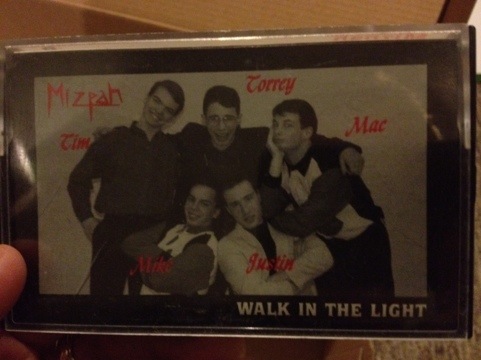
Mizpah
Still in regular contact with 4/5 of this Western Christian “super group”, I am personally stunned (do I mean “offended”?) that these tracks cannot be had on iTunes.  BUT they can be had in my basement… if you still own a cassette player.

20120224-023803.jpg

Any classics that you’ve discovered during past bouts of spring cleaning?