The Giver of Joy

The 2013 Advent Blog that my church is hosting continues to run.  Here was my recent post on the topic of JOY:

[ABOUT THE AUTHOR: Jason Bandura works with the Glen Elm Church of  Christ.  Married to Shannon, he is Dad to three lovely daughters.  He lives on the Canadian prairies and writes occasionally HERE.]

Is this an early Christian mission OR one of pop music’s teen idols battling for survival?

fansIn Acts 14, Paul and Barnabas have to fight off adoring fans. While preaching the Gospel with the city of Lystra, they healed a local cripple, sending the crowd into bedlam. The whispers-turned-to-shouts begin to revolve around a theory that the two missionaries are actually Zeus and Hermes mingling among humanity.

Paul and Barnabas were having none of it:

14 But when the apostles Barnabas and Paul heard of this, they tore their clothes and rushed out into the crowd, shouting: 15 “Men, why are you doing this? We too are only men, human like you. We are bringing you good news, telling you to turn from these worthless things to the living God, who made heaven and earth and sea and everything in them. 16 In the past, he let all nations go their own way. 17 Yet he has not left himself without testimony: He has shown kindness by giving you rain from heaven and crops in their seasons; he provides you with plenty of food and fills your hearts with joy.”

That last sentence recently grabbed my Advent-tuned mind.
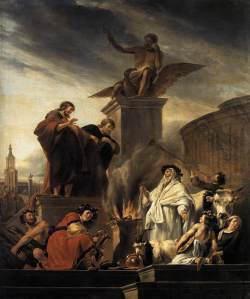
Paul_and_Barnabas_at_Lystra_-_1650Paul and Barnabas credited God as the Maker and Manager of all things, who refuses to micromanage. Instead, they observed this Overseer allowing for freedom, while providing low-key, you-will-need-to-listen-carefully testimony of His constant presence.

According to non-Zeus and non-Hermes, one of the things that argues for God is joy.

This intrigues.

One of the classic lines of doubt in God’s existence springs from a simple theory: If evil is in the world, surely God is not.  The question here connects with every heart that has hurt. In times of pain, it springs so quickly that one has no chance to even assess its substance on its way out.

In the struggle to believe in a God who hasn’t already obliterated evil, some turn to a worldview that involves no deity at all.  We were not created; we evolved. There is no Plan; just the ones we make. Life, by its nature, is utilitarian. The strong (ie: useful, functional, advantageous) survive, whether you speak of traits or ideas or people.  To observe Darwin’s theory in moths changing colour is one thing; to extend his thoughts into an overarching interpretation of reality is another.

This is where one consideration demands more attention: What to do with fun? Beauty? Pleasure?

In a world void of any good and gracious Provider, in a world governed by “the strong survive”, how does one interpret joy?

In matters of God, airtight argument is like the Holy Grail. It’s longed-for, but the longer you seek it, the less you believe it exists. Knowledge of spiritual things requires a different processor than mere reasoning, much to my logic-loving chagrin. Gratefully, I have been kindly chided into confession that it is a very good thing that there is more going on than I can grasp.

In a world that I could entirely understand, nonsense like joy would have no place.

Loose ThreadNineteen centuries ago, Paul and Barnabas contended that joy was a loose strand, begging to be tugged on.

Give it a pull.

If you do, it will pull back.

Saturday Six-Pack (23)

Imagine: A “Saturday Six-Pack” arriving on… wait for it… Saturday!

After two weeks of lateness and a week of absence, I’ve regained my position on the top of the pile!

Here’s your weekly fodder of faith, ministry, and who-knows-what tossed in!

If you need help starting, begin with my two *Picks of the Week*, and move from there.

For a steady stream of such links, follow me on Twitter ( @JasonBandura ) to the right of this post.  Sharp quotes and solid articles are tweeted 3-4 times daily.

Today’s edition:

1) Why Churches Should Euthanize Small Groups
Being part of a leadership team that has significantly increased our emphasis on Small Groups in recent years, this title grabbed me.  Author and pastor Brian Jones points out a few of the struggles that many of us have experienced…

2) What Legalists and Atheists Cannot Understand (*PICK OF THE WEEK*)
This little piece from the Gospel Coalition revolves around a late night visit between Christian apologist Larry Alex Taunton, Oxford mathematician John Lennox and the late Christopher Hitchens, author of “God is Not Great”.  Throw in some rich references to my favourite portion of Scripture, and I freely recommend this one.

3) Fourteen Indispensable Leadership Quotes from Jim Collins
Jim Collins is recognized across the board as a voice of wisdom on the theme of leadership. Here, Thom Rainer captures a couple touchdowns’ worth of his best bits.

4) Why Women are More Religious than Men
For Psychology Today, Nigel Barber puts forth a theory that I confess to find quite weak. A strand of truth is here, but more than anything, this article served to enlighten me on why people of faith must live out their convictions or else risk observers like Mr. Barber largely missing the whole point.

5) You Are Not a Computer (Try as You May)
Here’s my favourite line from this great piece from the Harvard Business Review is this: “What information consumes is rather obvious. It consumes the attention of its recipients. Hence a wealth of information creates a poverty of attention.”  That opinion was shared in 1970, and it is abundantly on-the-mark today.  Some thought-provoking stuff here on how to live well within the “information age”.  If I had a third *PICK OF THE WEEK*, I’d put it here.

6) The Science of Productivity (*PICK OF THE WEEK*)
I just discovered Gregory Ciotti’s site: SparringMind.  This post features a three-minute video (which I tweeted a link to, earlier today) that breaks down some of the science behind our minds work and how we might better work within that framework to be more efficient in spending our time and energy. Quite fascinating to me!

May your week be full of awareness and enjoyment of the God who already fills it with Himself and every good thing.  Blessings on you, my friends.

YOUR TURN: Direct other readers to the best stuff with a comment below, or weigh in on what you read.  Your input makes this post better!

[You can subscribe to this blog via RSS or email, in the upper right corner of this page.]

Bring Your Best

Bring Your Best

This poster is designed by (and available for purchase) at http://www.therussiansusedapencil.com/

You have a gift? You have a best?

Put them together, and serve them up today.

Grace and peace, my friends.

Peace for A Purpose

Slide1As I mentioned in an earlier postour church has created an Advent Blog each December for last few years.  Articles and reflections are submitted by members and friends of our congregation, on a variety of topics tied to the Advent season.  You are most welcome to join us in this annual pilgrimage toward Christmas.

My first submission was on HOPE.  This one is on PEACE.

[ABOUT THE AUTHOR: Jason Bandura works with the Glen Elm Church of  Christ.  Married to Shannon, he is Dad to three lovely daughters.  He lives on the Canadian prairies and writes occasionally HERE.]

Everyone craves peace.

We pray it for our nations and households. We seek it for our world and for our minds. The whole of humanity could sing together of the desire for a “peaceful, easy feeling”

If it ever arrived, what would we do with it?

The Old Testament prophet Malachi described a beautiful covenant that God had established with Levi, a figure from centuries earlier:

“My covenant was with him, a covenant of life and peace, and I gave them to him; this called for reverence and he revered me and stood in awe of my name. True instruction was in his mouth and nothing false was found on his lips. He walked with me in peace and uprightness, and turned many from sin.

“For the lips of a priest ought to preserve knowledge, and from his mouth men should seek instruction—because he is the messenger of the Lord Almighty.”

Levi, the namesake for Israel’s priestly tribe (the Levites) enjoyed a covenant with Yahweh, described as one “of life and peace”. Levi lived reverently, and in exchange, his life was empowered to influence others toward a similar way of life and peace.

The priests were to experience Yahweh’s peace. Why?

So that they could bless the tribes around them.

Picked up in the New Testament, priestly imagery gets attached to the followers of Jesus, who are identified as a “royal priesthood”, apparently called to fill the role of representatives between heaven and humanity. (This concept is observed in the common Protestant doctrine of the “priesthood of all believers”.)

We see the establishing of this role in John 20:

19 On the evening of that first day of the week, when the disciples were together, with the doors locked for fear of the Jews, Jesus came and stood among them and said, “Peace be with you!” 20 After he said this, he showed them his hands and side. The disciples were overjoyed when they saw the Lord.

21 Again Jesus said, “Peace be with you! As the Father has sent me, I am sending you.” 22 And with that he breathed on them and said, “Receive the Holy Spirit. 23 If you forgive anyone his sins, they are forgiven; if you do not forgive them, they are not forgiven.”

24 Now Thomas (called Didymus), one of the Twelve, was not with the disciples when Jesus came. 25 So the other disciples told him, “We have seen the Lord!”

But he said to them, “Unless I see the nail marks in his hands and put my finger where the nails were, and put my hand into his side, I will not believe it.”

26 A week later his disciples were in the house again, and Thomas was with them. Though the doors were locked, Jesus came and stood among them and said, “Peace be with you!”

To disciples locked away in fear that Jesus’ killers would soon hunt them down too, Jesus first spoke, “Peace.” Displaying himself as alive and victorious, he spoke the word again.  Having shared his peace with them, he now sent them into their world in the same manner that God has sent him into ours.  They received peace so that they might go into the world as representatives of the wholeness—the Shalom—that God is working to re-establish in His creation, one life at a time.

Poor Thomas misses this empowering experience.  But a week later, Jesus grants him the wound-examination he craves, after offering one key word of comfort: “Peace.”  We dare to see the same sending trajectory being established, even with the one famously called “doubting Thomas”.

How about Chennai, India?

Strong strands of tradition locate Thomas taking the Gospel of Jesus to the Indian sub-continent, as his response to Christ’s peace-sharing work in his life.

Apparently, tasting of God’s peace is a powerful enough experience to drive even an infamous doubter into offering himself as a Shalom-ambassador, at the exclusive disposal of the Infinite One.

Make no mistake: God wants to give you peace.

Just be sure you know why He wants to grant you such a gift.  You can be sure it is a grander design than a few more Z’s tonight.

A Missing Six-Pack

A weekend that included a hockey game, the funeral of a dear friend, and a gathering at our home got away from me!

The next edition of the Saturday Six-Pack is being drafted (along with a few other posts), and it WILL be released on Saturday.

Have a great week, my friends.