
Hope for the World

one wayOne facet of Christianity that rubs hard on many twenty-first-century minds is summed up tightly in this word: Exclusivity.

In a world of nearly infinite options, it seems unthinkable to some that one should feel “pigeon-holed” when it comes to the salvation.  And so we hang on the walls of our minds scenes of mountains with multiple paths of ascent or heavenly cloud-scapes reached by seven billion-plus uniquely crafted ladders.
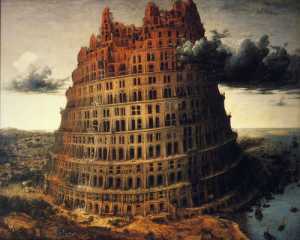
babelIn a sense, our hearts long for a return to the Tower of Babel, a design-as-you-wish blueprint that, if you are faithful in your efforts, will surely deliver you to whatever awaits “up there”.  “All roads lead to God” is the common tongue of every labourer on this scaffolding.

But as in Genesis 11, the word “gibberish” is quickly associated with this scenario.

vramachandraIn a twist on this discussion, Vinoth Ramathandra (a man to whom Timothy Keller introduced me) addresses an associated critique of Christianity, one that depicts religion as being dissociated from the “real world”, as being obsessed with the “spiritual” and out-of-touch, even inappropriately unconcerned, with the here-and-now world.

Ramathandra’s response will induce a pause for both hearty believers and hardened skeptics:

“Christian salvation lies not in an escape from this world but in the transformation of this world. You will not find hope for this physical world in any other religious system or philosophy. The biblical vision is unique.  And that is why if someone says, ‘Surely there is salvation in other faiths,’ I always ask them, ‘What salvation are you talking about?’

Not this salvation.

No faith holds out a promise of eternal salvation for the world like the cross and resurrection of Jesus Christ do.”

Christianity, if personified, is not the arrogant or presumptuous jerk that some portray, despite the fact that you may have met arrogant and presumptuous jerks with Bibles in hand.

Rather, Christian doctrine is unique by its very nature.  You can narrow your gaze on a concept like love or goodness, and then preach on the “common truth” that underlies all religions and philosophies, but you will only be adding to the static.  An observation like Ramathandra’s tunes in tighter to the signal and in turn, heightens the dialog.

HopeFor Christian fundamentalists, it highlights the care of God toward His current creation.  Unlike humanity, God is not always racing ahead to “what’s next”.  He deeply loves “what is” and is working for its redemption. For cynics of Christianity, such doctrine at least forces a reconsideration of the concept of hope.

What well do you draw yours from, not just for yourself but for the world in which you live?

Is there any?

Is it wrapped solely in the evolution and development of humanity? Strictly in scientific discovery? An alternative philosophy? A different religion?

YOUR TURN: What do you make of Ramathandra’s assessment of Christianity’s unique tone of hope for this world?  Christian or not, what are you striving to do/be as an agent of hope in our world?  Your input makes this post better!

[You can subscribe to this blog via RSS or email, in the upper right corner of this page.]

Loved Ones Love Well

Throughout the month of Advent, posts here have drawn from pieces submitted to the Glen Elm Church of Christ Advent Blog.  They have covered the four traditional themes of the season: Hope, Peace, Joy, and now Love.

In speaking of love, Scripture’s call to Christ’s followers is clear:

Be imitators of God, therefore, as dearly loved children and live a life of love, just as Christ loved us and gave himself up for us as a fragrant offering and sacrifice to God. (Ephesians 5:1-2)

The One who is love (1 John 4:16) tells the ones who are His, to mimic His ways. Revealed in Scripture as “gracious and compassionate, slow to anger and abounding in unfailing love”, this call to imitation is no light invitation.

How on earth could any of us live it out?

It is not that love is completely foreign to us. The vast majority of parents love their children without any nudging. Friends care for each other. Spouses cherish one another. The entire human race is said to bear the image of God, so it is hardly shocking that some “love genes” got passed from Father to children.

What is shocking though is how quickly love mutates into something less than divine.  And it is ME that taints the mixture. I don’t even mean that I add something that ruins the recipe. I mean that I am the something that taints the recipe.

And you do the same.

Well-intentioned and seeking the good, we march into St. Paul’s call. We will be “imitators of God”; we will “live a life of love”. With all the power in us, we will pursue this most holy call.

And we fail miserably, injuring others and ourselves in the process.  Our noblest efforts are undercut by insecurities that we mask and independence that we magnify.  Our hearts may long to love well, but our hearts are fragmented at best.  And when did something fractured ever show sufficient strength to live up to its billing?

No, if we are to be imitators of the love-God, it will require more than the powered housed within us.

A re-reading of the fine print in Ephesians 5:1-2 may make all the difference:

Be imitators of God, therefore, as dearly loved children and live a life of love, just as Christ loved us and gave himself up for us as a fragrant offering and sacrifice to God. (Ephesians 5:1-2)

There is one prerequisite to following God’s love-call with any measure of faithfulness; it is non-negotiable. No other credits will transfer in.  It is not that God is a stickler for details; it is simply that we cannot run before we walk.

Ahead of being loving, you must be loved.

Prior to imitating God’s loving ways, you must have felt God’s loving ways.

The topic of embracing, by faith, the love of God, even as it embraces us, could be the subject of a thousand posts.  (Perhaps this will serve as the first.)  But the conversation started here today is simply an affirmation that Paul knew of what he spoke: You cannot give what you do not have.

And if you do not have, it is not because the Being known as Love is holding back.

If even a sliver of suspicion has awakened within you, that a touch of God’s love might change life as you know it, seek Him in as exposed and trusting posture as you can strike and speak with those around you who appear to be living as “dearly loved children”.

I mean, who could dish out higher quality love than those called God’s “dearly loved children”?!

YOUR TURN: What barriers have you experienced in “moving into” the love of God? What advice would you offer someone who was seeking to feel more like a “dearly loved child”?  Your input makes this post better!

[You can subscribe to this blog via RSS or email, in the upper right corner of this page.]

“Dad, What’s a Funeral?”

funeral flowersA few Sundays back, I was upgrading my wardrobe from the shirt and pants that I had worn to morning service to a full-blown suit and tie for an afternoon funeral. My four-year-old asked me why I was dressing up. I told her that I was going to a funeral, and in vintage four-year-old fashion, she asked the perfect question…

“Dad, what’s the funeral?”

Is it wrong that I wanted to provide her with a definition that made no mention of death, for fear of not knowing how to answer the next inevitable question?

Thoughts around mortality have rolled through my head more lately than usual.  Some of it is involvement in recent funerals. Some of it is the experience of raising small children and noting how very quickly time seems to pass.  The math doesn’t lie, nor do my joints.  Time is marching on.

Andrew Peterson, on his fantastic new album, says it this way:

And we just can’t get used to being here,
Where the ticking clock is loud and clear,
Children of eternity,
On the run from entropy.

Whatever the specifics, a couple observations linger:

1) Dust to dust is indeed the human reality, and my someday-dust-but-not-yet mind can hardly fathom the concept.  How can it be that friends I enjoyed only weeks ago can no longer exist in the form which I always enjoyed them?  We spoke and laughed and hugged, yet today, all physical traces of that speaking mouth, laughing voice, and embracing frame have vanished.  And my head shakes.

2) My struggle to grasp our own ends pushes me to consider the greater mystery of God’s endlessness.  The Bible portrays the reality that the my bookends of birth and death are merely tiny points upon the infinite shelf of God. Before me and after me, He is the sea in which my life floats.  As Scripture describes it, He goes before me and follows behind me, all the while His hand is upon me.

At times, the sting of death can seem very real.  It cuts through any veneer we have layered on.  It can unnerve us, even undo us.  Andrew Peterson’s lyrics above are affirmed as true: We do not know what to do with death, so much so that one wonders if our original design truly included this wretched feature.

pauseBut as we know, loss feels plenty real.  Sorrow can strike with staggering force.  There is no evading this enemy.  That said, perishing carries a unique perk.  This is why a friend of mine calls death “the great interrupter”.  Nothing hits the pause button as forcefully as death.  Assessments occur; inventory is taken.

In those painfully still moments, sometimes we step back from the canvas just enough to observe the frame on the painting.  And it is then that we observe that life–even in its dust-to-dust nature–is encompassed by One larger than the cosmos.

Surrounded by such loving grandeur, one can indeed walk through the valley of the shadow of death without fear.

YOUR TURN: How have/would you handle discussing death with kids? What have you learned from your run-ins with mortality? Your input makes this post better!

[You can subscribe to this blog via RSS or email, in the upper right corner of this page.]

Saturday Six-Pack (24)

Welcome to Wandering & Wondering!

Just in time for Christmas, it’s your latest edition of the “Saturday Six-Pack”.

Typically centered on faith or ministry, you’re sure to find some who-knows-what tossed in!

If having a half-dozen options paralyzes you, begin with my two *Picks of the Week*, and move from there.

For a steady stream of such links, follow me on Twitter ( @JasonBandura ) to the right of this post.  Sharp quotes and solid articles are tweeted 3-4 times daily.

Today’s edition:

1) A Circle of Honour
One of the most powerful acts you can carry out in your relationships is to initiate experiences in which those around you are appreciated, honoured, and admired… and they know it!  Great piece from Leadership Journal.

2) Seven Questions with Scot McKnight (*PICK OF THE WEEK*)
Here, David Kinnaman and Scot McKnight take a look at recent Barna research on Christian women today, particularly women’s levels of satisfaction within the church. Whatever your own take on women’s roles in the Church today, Scot offers compelling perspectives on the research.  Men and women alike, your comments below on this piece could start a fascinating discussion.

3) The Paradox of Advent
This reflective prayer vividly describes the real wonder of the Christmas season.  Thanks for sharing, Scotty Smith.  If you need one more worthwhile tweeter to follow, @ScottyWardSmith will do you well.

4) Six Reasons a Pastor Should Work a Month in Advance
Mark Pierce makes a few compelling (yet brief) arguments for why more pastors might wish to pursue this approach to preaching.  Read it before you wonder, “But how would I ever pull that off?”  Then Google a quote about a will and a way.  Then decide what your next step might be.

5) Best Mac Apps of 2012
For Mac-lovers who enjoy finding new programs and such, this list may provide some enlightenment. If anything, the list made me realize that I use my iPhone for a lot of things that I don’t even address on my computer.  Several of these apps were also focused on more creative folks than myself.

6) How Social Media is Destroying Productivity (*PICK OF THE WEEK*)
An article featured in last week’s Six-Pack contained this line: “What information consumes is rather obvious. It consumes the attention of its recipients. Hence a wealth of information creates a poverty of attention.” And a poverty of attention is one of the impacts of social media. This infographic (by ChurchMag) portrays the stats most interestingly.

Merry Christmas to all of you!  May your week be unusually full of an awareness of just how very close God has come.

Blessings on you, my friends.

YOUR TURN: Direct other readers to the best stuff with a comment below, or weigh in on what you read.  Your input makes this post better!

[You can subscribe to this blog via RSS or email, in the upper right corner of this page.]

Hell: A Reality Worse than the Imagery

love-wins-setThe topic of hell has received an unusual amount of attention in Western theological discussion over the past decade.  Of course, the most popular strand of this discussion centered around Rob Bell’s book “Love Wins”, with denser strands weaving through the academic realms of publication and discussion.

Much of the conversation is built around distaste for the concept of never-ending punishment, particularly as it is wrapped in imagery of fire and burning.  This leads to several valid questions:

  • What depiction of hell is truly biblical, and what has been developed through the art and literature of the ages?
  • How literally or metaphorically are we to take what Scripture does tell of the final judgment?
  • What do biblical words like “Gehenna” really mean?

These are just a sampling of the sub-topics that factor into the larger discussion of “What do you make of the concept of hell?”  Certainly, this discussion matters; to some, it appears to matter immensely.

I am not among that number.

Part of that is due to the following quote from Timothy Keller:keller3

“To say that Scripture’s image of hellfire isn’t wholly literal is no comfort whatsoever—the reality will be far worse than the image.”

We can hardly be blamed for our flesh-fettered views. Nerves and neurons, skin and sensation, these are the means by which we experience our world. And in that light, it is easy to see why heaven’s depiction is golden and lavish, while hell’s is dark and despairing.

But what if our senses misguide us?

sensesWhat if the imagery–as vivid as imagery and language can formulate–fails to capture the intensity?

What if the most intense scenes of suffering that a human imagination can generate are pitifully poor metaphors for communicating the reality of a creature cut off from its Creator?

It seems easy to convince people that heaven will actually surpass an experience revolving around golden streets and massive mansions.  We recognize that the extravagant physical depictions fail to express even a sliver of the spiritual reality. We acknowledge that the core of that experience will center upon the overwhelming and unmissable presence of God and upon the river of life-to-the-full that will flood-flow from Him to His companions.

Humanity’s heaven imagery is pale and poor to communicate the intensity of the reality.

Yet seldom is an equivalent argument applied to hell.  And if the case is made, then it’s made only halfway.  It is one step to recognize the limitations of imagery and vocabulary.  One can say that without saying much.

But it is a big-as-a-beast statement to suggest that the imagery of hell, the metaphors that make us squirm, even buck against the entire concept, are actually too weak to communicate the magnitude of the reality.

If heaven is actually better than jewel-encrusted architecture, then the counter-statement stands too.

Hell is worse than burning.

C.s.lewis3C.S. Lewis used to speak of “the unsmiling concentration upon Self, which is the mark of hell.”  Unchecked and freely reigning within a life, self-centeredness consumes in ways sparks never will.  It scars the soul and warps one’s world.  And it appears that anyone who desires this path can have it. So powerfully are we created that our choices in the present life ripple through eternity.

But we’d be wise to make our choices, aware that the imagery is not nearly so fierce as the reality.

Hell is worse than burning.

YOUR TURN: How do you handle the Bible’s imagery of the afterlife, in light of the thought that the imagery is actually light-weight when compared to the reality?

Become part of the conversation. Your voice makes this post better.

[You can subscribe to this blog via RSS or email, in the upper right corner of this page. As well, follow me on Twitter ( @JasonBandura ) for 3-4 daily tweets daily of of insightful quotes or intriguing articles, sprinkled with occasional goofiness.]