Tradition

In my cynical moments, I like posters like that one.  But not all my moments are cynical, gratefully.

Much of my inner “tradition discussion” has to do with faith and how it plays out in my life or in the life of my faith community.  I struggle from day to day, bouncing from stances that would seem anti-traditional to others that would seem ultra-traditional.  Call me bi-polar if you wish, but that’s where I am.

A reading today brought some valuable thoughts on the subject, from J.I. Packer…

“Nobody can claim to be detached from traditions.  In fact, one sure way to be swallowed up by traditionalism is to think that one is immune to it…. The questions, then, is not whether we have traditions, but whether our traditions conflict with the only absolute standard in these matters: Holy Scripture.”

He continues…

“All Christians are at once beneficiaries and victims of tradition–beneficiaries, who receive nurturing truth and wisdom from God’s faithfulness in past generations; victims, who now take for granted things that need to be questioned, thus treating as divine absolutes patterns of belief and behavior that should be seen as human, provisional, and relative.  We are all beneficiaries of good, wise, and sound tradition and victims of poor, unwise, and unsound traditions.”

And now to know the difference.

And now to act upon that knowledge wisely.

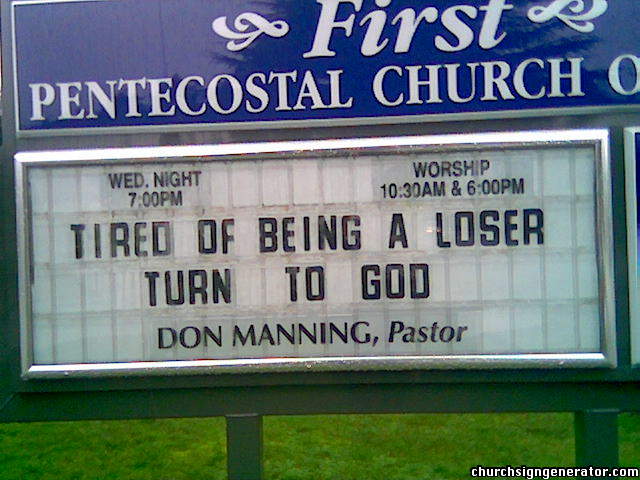
Friday Church Signs

There was a time when church signs aimed to be informational.  At the least, they aimed to be encouraging, thoughtful, or even humourous.

When did “bone-headed” become the goal?

I wonder how many God-seeking guests Pastor Manning spoken to that weekend…

Those Good ‘Ole Church Questions (2/30)

I never said all thirty of these would be originals, so let me stitch a few pieces together that my brother-in-law has tossed out there.

Here was recent post of his…

A few months ago I cancelled my bloglines subscriptions to many emerging / postmodern / missional / do-church-different blogs.

Yes, there is a time to criticize, reflect upon and review how things are being done, but it’s just not helpful to sit deeply in that posture for long – you end up stiff, cranky and critical. Better to get up and get busy doing things the the best way that you know how. I needed to be doing.

Just like in many areas of my life, I realized I was educated way beyond my obedience. For now, I’ve read enough about new paradigms, structures and church plants. I know the arguments for mega-church, house-church, wholistic-organic-church and frankly I’m not really convinced that one is any better than another. Sticking the word missional on something doesn’t make it missional. Finding your particular church structure in history doesn’t make you right.

The groups of Followers that I want to learn from don’t write blogs or books about “how it should be done.” They are too caught up in doing it and it’s too messy to fit into a new “paradigm.” I am realizing that there comes a time when a drop of inspiration is much more valuable than a waterfall of education.

Now, I can appreciate a few of those feelings, as I’ve often wondered how anyone (specifically myself) is to make much sense (I mean, actually reach useful points of conclusion) of all the things that are bound to come up over coffee with some of my “wanting to make church better” friends.

So I particularly enjoyed this Eugene Peterson quote, though I have no idea where it’s from (Here points to here, which points back to here, where I couldn’t find it!)…

“What other church is there besides institutional? There’s nobody who doesn’t have problems with the church, because there’s sin in the church. But there’s no other place to be a Christian except the church. There’s sin in the local bank. There’s sin in the grocery stores. I really don’t understand this naïve criticism of the institution. I really don’t get it. Frederick von Hugel said the institution of the church is like the bark on the tree. There’s no life in the bark. It’s dead wood. But it protects the life of the tree within. And the tree grows and grows. If you take the bark off, it’s prone to disease, dehydration, death. So, yes, the church is dead but it protects something alive. And when you try to have a church without bark, it doesn’t last long. It disappears, gets sick, and it’s prone to all kinds of disease, heresy, and narcissism.”

So to those who spend thought on such things, there are a couple more logs to throw on your fire.

Wondering

No idea what to title this post, so I’m stealing from myself…

In my quiet house, I finished “Telling Secrets” by Frederick Buechner tonight. 

Towards the end, he speaks about some healing experiences he had through involvement with an AA group. 

The thoughts that followed echoed in the corridor where my mind camps out occasionally…

“I do not believe that such groups as these… or Alcoholics Anonymous… are perfect anymore than anything human is perfect, but I believe that the church has an enormous amount to learn from them. 

I also believe that what goes on in them is far closer to what Christ meant his church to be, and what it originally was, than much of what goes on in most churches I know. 

These groups have no buildings or official leadership or money. 

They have no rummage sales, no preachers, no choirs, no liturgy, no real estate. 

They have no creeds.  They have no program. 

They make you wonder if the best thing that could happen to many a church might not be to have its building burn down and to lose all its money. 

Then all that the people would have left would be God and each other.”

“The Church of Irresistible Influence”: Part I

A Few Points from…

“The Church of Irresistible Influence”
by Robert Lewis and Rob Wilkins

INTRODUCTION

The book begins with a quote from Robert Kennedy…

“Some men see things as they are and say ‘why?’… I dream of things that are not, and say ‘why not?’”

Then the author asks for some imagination to be used…

Can you imagine the community in which you live being genuinely thankful for your church?
Can you imagine city leaders valuing your church’s friendship and participation in the community—even asking for it?
Can you imagine the neighbourhoods around your church talking behind your back about “how good it is” to have you church in the area because of the tangible witness you’ve offered them of God’s love?
Can you imagine a large number of church members actively engaged in, and passionate about, community service, using their gifts and abilities in ways and at levels they never thought possible?
Can you imagine the community actually changing (Proverbs 11:11) because of the impact of your church’s involvement?
Can you imagine many in your city, formerly cynical and hostile toward Christianity, actually praising God for your church and the positive contributions your members have made in Jesus’ name?
Can you imagine the spiritual harvest that would naturally follow if all this were true?

Continue reading