Worry Results from Allowing Fear to Imagine the Invisible

worryWe all know there’s no value in worrying.

If a parent or teacher failed to personally tell us, voices throughout history are eager to chime in:

“Worry is interest paid on trouble before it comes due.” (William Ralph Inge)

“Worry does not empty tomorrow of its sorrow. It empties today of its strength.” (Corrie ten Boom)

“Pray, and let God worry.” (Martin Luther)

“There is nothing that wastes the body like worry, and one who has any faith in God should be ashamed to worry about anything whatsoever.” (Mahatma Gandhi)

Yet for all the persuasive voices speaking all the compelling words, worry takes hold on our souls.  What counter-move might we make against its persistent grip?

Charles Swindoll has offered this perspective:

“On the day Jesus was crucified, it would have appeared to anyone seeing through eyes of flesh that the darkness, the devil, and death had defeated the Son of God once and for all. I will admit that those three D’s lie at the root of almost every worry I suffer. I worry about DEATH – in particular, the death of the people I love. I worry about DARKNESS, both literal and figurative. I worry about what the DEVIL is up to. All three worked diligently throughout the ministry of Jesus to bring about this long and anguishing day. But what no one could see was that the Messiah’s death would strike at the very heart of evil.”

Worry results from allowing fear to imagine the invisible.

To be sure, there will always be an invisible realms–questions without answers, ventures without guarantees. Life, by its nature, is filled with blanks.

But the message of Scripture is that much of that space is filled by a God whose very nature is gracious and compassionate, slow to become angry and abounding in steadfast love.  Seen most vividly in Jesus’ death and resurrection, we are dared to rein in our ability to quickly imagine the worst, in exchange for a freedom to steadily believe the best.

The Bible’s opening scene depicts a God of light that dwells in the darkness and a God of order than hovers over the chaos.  As Swindoll said above, these lessons were re-affirmed for all time in what we thought were the darkest moments of all.

As God says numerous times in Scripture, “Do not be afraid, for I am with you.”

And He is.

Even more than you would believe!

YOUR TURN: How do you handle fear?  In what ways has your faith impacted your tendencies toward worry?  YOUR COMMENTS MAKE THIS POST BETTER.

[You can subscribe to this blog via RSS or email, in the upper right corner of this page.]

A Year in the Scriptures

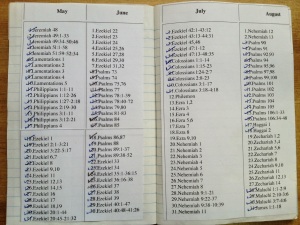
A year ago, I got myself organized by formatting our church’s Scripture reading schedule to fit neatly in my Bible cover. Below are three photos chronicling my success (and other things) in this venture:
20130101-094746.jpg

2012 Reading Schedule - Pic 22012 Reading Schedule - Pic 3A few observations may resonate with anyone who has ever tried to firmly establish a good habit:

1) Starting strong is admirable, but the real learning will take place miles from the gate you so eagerly burst forth from.

2) Life’s circumstances must be factored in. The birth of our third child, on May 28, and the rhythmic irregularities of summertime both had an obvious impact on my devotional habits.  “Creatures of habit” is sometimes tossed around as a derogatory term, but I view it as fact to be utilized wisely.  Craft the rhythms on which to build the habits, and you shape the creature you become. Do this wisely, but allow enough grace that you don’t despair when life’s special circumstances “interrupt”.

3) Reassessment and readjustment are key to ongoing success. Mid-November marked a conversation with my wife, in which we collectively planned how we desired to improve the scheduling patterns of our family life. The impact of those adjustments is obvious over the last six weeks of the calendar.

For any Christian – regardless of gender, age, or experience –  some form of Scripture diet is essential. I have never yet heard of a substantial spiritual life being cultivated apart from a love of Scripture.

A recent article by the Gospel Coalition offers five highly focused and practical tips toward developing one’s devotional habits.  If you have yet to settle upon a reading plan, do yourself a huge favour and choose one.  Numerous options can be found HERE or HERE.As well, you can view the Three Year Bible Reading Plan that our church uses. (We are just now entering year two of the cycle.)

If this habit is already well-established in your life, then you need little convincing to continue. If this habit is not yet established in your life, then today, this year, our gifts to you as entry points to the deeper realms of life available to all who seek God with all their hearts.

YOUR TURN: What have you discovered in your efforts to create Scripture and prayer rhythms in your life?  Any tips on what to do OR what not to do? Your input makes this post better!

[You can subscribe to this blog via RSS or email, in the upper right corner of this page.]
Hope for the World

one wayOne facet of Christianity that rubs hard on many twenty-first-century minds is summed up tightly in this word: Exclusivity.

In a world of nearly infinite options, it seems unthinkable to some that one should feel “pigeon-holed” when it comes to the salvation.  And so we hang on the walls of our minds scenes of mountains with multiple paths of ascent or heavenly cloud-scapes reached by seven billion-plus uniquely crafted ladders.

babelIn a sense, our hearts long for a return to the Tower of Babel, a design-as-you-wish blueprint that, if you are faithful in your efforts, will surely deliver you to whatever awaits “up there”.  “All roads lead to God” is the common tongue of every labourer on this scaffolding.

But as in Genesis 11, the word “gibberish” is quickly associated with this scenario.

vramachandraIn a twist on this discussion, Vinoth Ramathandra (a man to whom Timothy Keller introduced me) addresses an associated critique of Christianity, one that depicts religion as being dissociated from the “real world”, as being obsessed with the “spiritual” and out-of-touch, even inappropriately unconcerned, with the here-and-now world.

Ramathandra’s response will induce a pause for both hearty believers and hardened skeptics:

“Christian salvation lies not in an escape from this world but in the transformation of this world. You will not find hope for this physical world in any other religious system or philosophy. The biblical vision is unique.  And that is why if someone says, ‘Surely there is salvation in other faiths,’ I always ask them, ‘What salvation are you talking about?’

Not this salvation.

No faith holds out a promise of eternal salvation for the world like the cross and resurrection of Jesus Christ do.”

Christianity, if personified, is not the arrogant or presumptuous jerk that some portray, despite the fact that you may have met arrogant and presumptuous jerks with Bibles in hand.

Rather, Christian doctrine is unique by its very nature.  You can narrow your gaze on a concept like love or goodness, and then preach on the “common truth” that underlies all religions and philosophies, but you will only be adding to the static.  An observation like Ramathandra’s tunes in tighter to the signal and in turn, heightens the dialog.

HopeFor Christian fundamentalists, it highlights the care of God toward His current creation.  Unlike humanity, God is not always racing ahead to “what’s next”.  He deeply loves “what is” and is working for its redemption. For cynics of Christianity, such doctrine at least forces a reconsideration of the concept of hope.

What well do you draw yours from, not just for yourself but for the world in which you live?

Is there any?

Is it wrapped solely in the evolution and development of humanity? Strictly in scientific discovery? An alternative philosophy? A different religion?

YOUR TURN: What do you make of Ramathandra’s assessment of Christianity’s unique tone of hope for this world?  Christian or not, what are you striving to do/be as an agent of hope in our world?  Your input makes this post better!

[You can subscribe to this blog via RSS or email, in the upper right corner of this page.]

Loved Ones Love Well

Throughout the month of Advent, posts here have drawn from pieces submitted to the Glen Elm Church of Christ Advent Blog.  They have covered the four traditional themes of the season: Hope, Peace, Joy, and now Love.

In speaking of love, Scripture’s call to Christ’s followers is clear:

Be imitators of God, therefore, as dearly loved children and live a life of love, just as Christ loved us and gave himself up for us as a fragrant offering and sacrifice to God. (Ephesians 5:1-2)

The One who is love (1 John 4:16) tells the ones who are His, to mimic His ways. Revealed in Scripture as “gracious and compassionate, slow to anger and abounding in unfailing love”, this call to imitation is no light invitation.

How on earth could any of us live it out?

It is not that love is completely foreign to us. The vast majority of parents love their children without any nudging. Friends care for each other. Spouses cherish one another. The entire human race is said to bear the image of God, so it is hardly shocking that some “love genes” got passed from Father to children.

What is shocking though is how quickly love mutates into something less than divine.  And it is ME that taints the mixture. I don’t even mean that I add something that ruins the recipe. I mean that I am the something that taints the recipe.

And you do the same.

Well-intentioned and seeking the good, we march into St. Paul’s call. We will be “imitators of God”; we will “live a life of love”. With all the power in us, we will pursue this most holy call.

And we fail miserably, injuring others and ourselves in the process.  Our noblest efforts are undercut by insecurities that we mask and independence that we magnify.  Our hearts may long to love well, but our hearts are fragmented at best.  And when did something fractured ever show sufficient strength to live up to its billing?

No, if we are to be imitators of the love-God, it will require more than the powered housed within us.

A re-reading of the fine print in Ephesians 5:1-2 may make all the difference:

Be imitators of God, therefore, as dearly loved children and live a life of love, just as Christ loved us and gave himself up for us as a fragrant offering and sacrifice to God. (Ephesians 5:1-2)

There is one prerequisite to following God’s love-call with any measure of faithfulness; it is non-negotiable. No other credits will transfer in.  It is not that God is a stickler for details; it is simply that we cannot run before we walk.

Ahead of being loving, you must be loved.

Prior to imitating God’s loving ways, you must have felt God’s loving ways.

The topic of embracing, by faith, the love of God, even as it embraces us, could be the subject of a thousand posts.  (Perhaps this will serve as the first.)  But the conversation started here today is simply an affirmation that Paul knew of what he spoke: You cannot give what you do not have.

And if you do not have, it is not because the Being known as Love is holding back.

If even a sliver of suspicion has awakened within you, that a touch of God’s love might change life as you know it, seek Him in as exposed and trusting posture as you can strike and speak with those around you who appear to be living as “dearly loved children”.

I mean, who could dish out higher quality love than those called God’s “dearly loved children”?!

YOUR TURN: What barriers have you experienced in “moving into” the love of God? What advice would you offer someone who was seeking to feel more like a “dearly loved child”?  Your input makes this post better!

[You can subscribe to this blog via RSS or email, in the upper right corner of this page.]

The Giver of Joy

The 2013 Advent Blog that my church is hosting continues to run.  Here was my recent post on the topic of JOY:

[ABOUT THE AUTHOR: Jason Bandura works with the Glen Elm Church of  Christ.  Married to Shannon, he is Dad to three lovely daughters.  He lives on the Canadian prairies and writes occasionally HERE.]

Is this an early Christian mission OR one of pop music’s teen idols battling for survival?

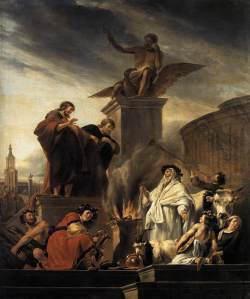
fansIn Acts 14, Paul and Barnabas have to fight off adoring fans. While preaching the Gospel with the city of Lystra, they healed a local cripple, sending the crowd into bedlam. The whispers-turned-to-shouts begin to revolve around a theory that the two missionaries are actually Zeus and Hermes mingling among humanity.

Paul and Barnabas were having none of it:

14 But when the apostles Barnabas and Paul heard of this, they tore their clothes and rushed out into the crowd, shouting: 15 “Men, why are you doing this? We too are only men, human like you. We are bringing you good news, telling you to turn from these worthless things to the living God, who made heaven and earth and sea and everything in them. 16 In the past, he let all nations go their own way. 17 Yet he has not left himself without testimony: He has shown kindness by giving you rain from heaven and crops in their seasons; he provides you with plenty of food and fills your hearts with joy.”

That last sentence recently grabbed my Advent-tuned mind.

Paul_and_Barnabas_at_Lystra_-_1650Paul and Barnabas credited God as the Maker and Manager of all things, who refuses to micromanage. Instead, they observed this Overseer allowing for freedom, while providing low-key, you-will-need-to-listen-carefully testimony of His constant presence.

According to non-Zeus and non-Hermes, one of the things that argues for God is joy.

This intrigues.

One of the classic lines of doubt in God’s existence springs from a simple theory: If evil is in the world, surely God is not.  The question here connects with every heart that has hurt. In times of pain, it springs so quickly that one has no chance to even assess its substance on its way out.

In the struggle to believe in a God who hasn’t already obliterated evil, some turn to a worldview that involves no deity at all.  We were not created; we evolved. There is no Plan; just the ones we make. Life, by its nature, is utilitarian. The strong (ie: useful, functional, advantageous) survive, whether you speak of traits or ideas or people.  To observe Darwin’s theory in moths changing colour is one thing; to extend his thoughts into an overarching interpretation of reality is another.

This is where one consideration demands more attention: What to do with fun? Beauty? Pleasure?

In a world void of any good and gracious Provider, in a world governed by “the strong survive”, how does one interpret joy?

In matters of God, airtight argument is like the Holy Grail. It’s longed-for, but the longer you seek it, the less you believe it exists. Knowledge of spiritual things requires a different processor than mere reasoning, much to my logic-loving chagrin. Gratefully, I have been kindly chided into confession that it is a very good thing that there is more going on than I can grasp.

In a world that I could entirely understand, nonsense like joy would have no place.

Loose ThreadNineteen centuries ago, Paul and Barnabas contended that joy was a loose strand, begging to be tugged on.

Give it a pull.

If you do, it will pull back.