A Two-Word Spiritual Secret

prayer_0If God would answer any one prayer of yours, what would you ask for?

What if He gave it to you? Removed it for you? Placed you there? Granted your request?

How satisfying would that be? How fulfilling or relieving? How would you revel in the experience of God’s obvious blessing upon you?

In the past year of life, two words have come to be key in my understanding of how AND why God works in our lives. The words are SO THAT.

SoThat

Spoken another way, God works in YOUR life for way MORE than YOUR life.

Scripture attests to this.

abraham baby hope smallAbraham longed for a child, for an heir. And God responded, but not merely because Abraham’s possessions needed a landing spot after his death nor because Abraham and Sarah’s home would be happier, filled with the cooing and cuddling that an infant brings.  No, God spoke of all the nations receiving blessing through this longed-for child. He blessed Abraham SO THAT…

moses-and-the-burning-bush-the-bible-27076046-400-300Moses should have been a grateful man. Shrewd scheming by his mother and sister allowed him enough life to learn how to walk. Then compassion in the heart of an Egyptian princess entitled him to a privileged upbringing within the ruling house of an ancient superpower. All of this was far beyond earning; it appeared to gifted, for no obvious reason.

After you have been involved in an accident which resulted in these damages, you can file a lawsuit against the at-fault party’s insurance provider. What is punitive damages if the at-fault party did not have insurance, or could claim compensation by requesting a payout from your own insurance company.

Then surprisingly, a wilderness exile helped him escape a murder charge and enrolled him into a forty-year leadership course, under the tutelage of father-in-law Jethro, numerous sheep, and the patient instruction of the desert. And all of this appears to be kindness spent on Moses for his sake until a shrub ignites and the Sacred Infinity says otherwise: “Your life, Moses, has not been about your life. All of this has taken place SO THAT…

pentecost1The first disciples were terrified. Their leaders had crucified their Leader, and there was no telling how many of them were destined for similar fates. Drowning in despair and filled with fear, they locked themselves away to weather the storm. But the drama of an untimely death was about to be vaporized by the reality of resurrection. Appearing among his followers, Jesus provoked in them a reinterpretation of all they thought they knew. He then urged them to wait in Jerusalem for the further wonder of the Spirit. God made these moves in the lives of the inner circle, with His eyes beholding a whole lot more… than the inner circle.  Fire fell from heaven as more than an encouragement to Jesus’ friends. God was moving SO THAT…

By nature, our gaze is narrow. But the tightening of our focus upon ourselves actually serves to rob us, for the glory of what God is up to is typically brightest in the “SO THAT” seen far beyond the borders of our lives.

To be sure, God IS working in your life. But the more wonderful truth is that He is working in your life, not merely for your life. The Holy One is the master of the SO THAT!

Wearing the Surprising Yoke of Christ

This invitation is among Jesus’ most famous words (Mt 11:28-30):

“Come to me, all who labor and are heavy-laden, and I will give you rest. Take my yoke upon you, and learn from me, for I am gentle and lowly in heart, and you will find rest for your souls. For my yoke is easy, and my burden is light.”

YokeTillers International put out a document on how to build a yoke (in case you were looking for a wood shop project).  They noted that a typical wooden yoke might weigh 50-60 pounds, certainly more than I’d care to carry in a backpack each day but hardly problematic to a team of animals who might weigh a couple tons collectively.

That got me to thinking about the yoke Jesus offers.

He says that it will not feel burdensome. He also says that wearing it will be a form of learning.

Here is where the image surprises.

Yoke-talk was common-place among first-century rabbis. It spoke of whose rule one was living out, whose Torah-interpretation one was holding, whose “way” one was walking.  Typically, potential students might approach a teacher under whom they desired to learn.  Some sort of “application” would take place, with testing and gauging of whether this student was suitable for this master.  Jesus splits from the standard operating procedures immediately by putting out a call of invitation, particularly to those whose current yokes are crushing them. To the wearied and the worn, a restful yoke awaits.

How can it be so?

I mean, Jesus is the same one who called his followers to “be holy, as God is holy”. He told them that they would need to pursue a higher form of righteousness than the minutia-minded Sinai-sticklers of their day, so we can safely conclude that he was not speaking of slack standards or halfway holiness.

Perhaps the clue lies in the imagery of the yoke.

Yoke-Jesus-Matthew-11-28-30-300x225Picture it.

See the metaphor: View the farm, hear the livestock, assess the fields to work.

Imagine it.

Place yourself there: Smell the dirt, breathe the air, feel the weight of a yoke.

At this moment, where is Jesus?

If there is a yoke and we are wearing it, then it seems easy enough to assess our spot in the sketch. We are the beast of burden, ready to plow under the watch of a master. Simple enough.

But where is Jesus?

That seems easy too.

I mean, if he’s the owner of the yoke, then he is the farmer, intent on training us to be obedient and useful to himself.  Every facet of that metaphor works for standard Christian teaching.

However, I cannot help but wonder if we’re missing a key–a very key–detail.

Farmer with working elephant. IndiaYears ago, my wife and I spent time in southeast Asia. At a number of spots, we encountered elephants: We rode some, we fed some, we visited reserves and protection programs.  We also witnessed elephants being used as work-animals. Be assured, you can get some stuff done with an elephant! Who needs horsepower when you’ve got elephant power and a trunk?!

One of the trainers said that when they’re working with a new elephant, they match him up with their best elephant. The rookie gets yoked alongside the expert. He gets mastered; he gets discipled.

And that is what I think we’re missing when we read Matthew 11.

It makes all kinds of sense to see Jesus as the yoke-owning, beast-breaking farmer.

Perhaps it makes all kinds of more sense to see Jesus as the yoke-sharing, way-walking beast beside us.

He straps us to himself and shows us how to walk.  Like stubborn elephants, we pull against and jostle with the yoke and the partner. And like the steady guide, he holds the line, graciously allowing us to learn and adjust. When pride breaks and rebellion subsides, we discover that we can sync our strides to this steady companion.

And in that moment of coordination and partnership, we discover that we don’t even notice the yoke upon us.  The load is shared, and truth be told, he is bearing the weight so completely that our portion merits no mention.  Beyond that, we begin to realize that a life of satisfying fruitfulness has begun.

Welcome to the life of the disciple!

Loved Ones Love Well

Throughout the month of Advent, posts here have drawn from pieces submitted to the Glen Elm Church of Christ Advent Blog.  They have covered the four traditional themes of the season: Hope, Peace, Joy, and now Love.

In speaking of love, Scripture’s call to Christ’s followers is clear:

Be imitators of God, therefore, as dearly loved children and live a life of love, just as Christ loved us and gave himself up for us as a fragrant offering and sacrifice to God. (Ephesians 5:1-2)

The One who is love (1 John 4:16) tells the ones who are His, to mimic His ways. Revealed in Scripture as “gracious and compassionate, slow to anger and abounding in unfailing love”, this call to imitation is no light invitation.

How on earth could any of us live it out?

It is not that love is completely foreign to us. The vast majority of parents love their children without any nudging. Friends care for each other. Spouses cherish one another. The entire human race is said to bear the image of God, so it is hardly shocking that some “love genes” got passed from Father to children.

What is shocking though is how quickly love mutates into something less than divine.  And it is ME that taints the mixture. I don’t even mean that I add something that ruins the recipe. I mean that I am the something that taints the recipe.

And you do the same.

Well-intentioned and seeking the good, we march into St. Paul’s call. We will be “imitators of God”; we will “live a life of love”. With all the power in us, we will pursue this most holy call.

And we fail miserably, injuring others and ourselves in the process.  Our noblest efforts are undercut by insecurities that we mask and independence that we magnify.  Our hearts may long to love well, but our hearts are fragmented at best.  And when did something fractured ever show sufficient strength to live up to its billing?

No, if we are to be imitators of the love-God, it will require more than the powered housed within us.

A re-reading of the fine print in Ephesians 5:1-2 may make all the difference:

Be imitators of God, therefore, as dearly loved children and live a life of love, just as Christ loved us and gave himself up for us as a fragrant offering and sacrifice to God. (Ephesians 5:1-2)

There is one prerequisite to following God’s love-call with any measure of faithfulness; it is non-negotiable. No other credits will transfer in.  It is not that God is a stickler for details; it is simply that we cannot run before we walk.

Ahead of being loving, you must be loved.

Prior to imitating God’s loving ways, you must have felt God’s loving ways.

The topic of embracing, by faith, the love of God, even as it embraces us, could be the subject of a thousand posts.  (Perhaps this will serve as the first.)  But the conversation started here today is simply an affirmation that Paul knew of what he spoke: You cannot give what you do not have.

And if you do not have, it is not because the Being known as Love is holding back.

If even a sliver of suspicion has awakened within you, that a touch of God’s love might change life as you know it, seek Him in as exposed and trusting posture as you can strike and speak with those around you who appear to be living as “dearly loved children”.

I mean, who could dish out higher quality love than those called God’s “dearly loved children”?!

YOUR TURN: What barriers have you experienced in “moving into” the love of God? What advice would you offer someone who was seeking to feel more like a “dearly loved child”?  Your input makes this post better!

[You can subscribe to this blog via RSS or email, in the upper right corner of this page.]

The Giver of Joy

The 2013 Advent Blog that my church is hosting continues to run.  Here was my recent post on the topic of JOY:

[ABOUT THE AUTHOR: Jason Bandura works with the Glen Elm Church of  Christ.  Married to Shannon, he is Dad to three lovely daughters.  He lives on the Canadian prairies and writes occasionally HERE.]

Is this an early Christian mission OR one of pop music’s teen idols battling for survival?

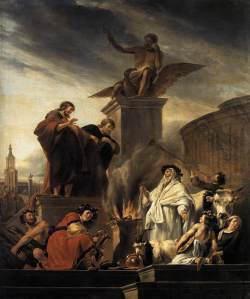
fansIn Acts 14, Paul and Barnabas have to fight off adoring fans. While preaching the Gospel with the city of Lystra, they healed a local cripple, sending the crowd into bedlam. The whispers-turned-to-shouts begin to revolve around a theory that the two missionaries are actually Zeus and Hermes mingling among humanity.

Paul and Barnabas were having none of it:

14 But when the apostles Barnabas and Paul heard of this, they tore their clothes and rushed out into the crowd, shouting: 15 “Men, why are you doing this? We too are only men, human like you. We are bringing you good news, telling you to turn from these worthless things to the living God, who made heaven and earth and sea and everything in them. 16 In the past, he let all nations go their own way. 17 Yet he has not left himself without testimony: He has shown kindness by giving you rain from heaven and crops in their seasons; he provides you with plenty of food and fills your hearts with joy.”

That last sentence recently grabbed my Advent-tuned mind.

Paul_and_Barnabas_at_Lystra_-_1650Paul and Barnabas credited God as the Maker and Manager of all things, who refuses to micromanage. Instead, they observed this Overseer allowing for freedom, while providing low-key, you-will-need-to-listen-carefully testimony of His constant presence.

According to non-Zeus and non-Hermes, one of the things that argues for God is joy.

This intrigues.

One of the classic lines of doubt in God’s existence springs from a simple theory: If evil is in the world, surely God is not.  The question here connects with every heart that has hurt. In times of pain, it springs so quickly that one has no chance to even assess its substance on its way out.

In the struggle to believe in a God who hasn’t already obliterated evil, some turn to a worldview that involves no deity at all.  We were not created; we evolved. There is no Plan; just the ones we make. Life, by its nature, is utilitarian. The strong (ie: useful, functional, advantageous) survive, whether you speak of traits or ideas or people.  To observe Darwin’s theory in moths changing colour is one thing; to extend his thoughts into an overarching interpretation of reality is another.

This is where one consideration demands more attention: What to do with fun? Beauty? Pleasure?

In a world void of any good and gracious Provider, in a world governed by “the strong survive”, how does one interpret joy?

In matters of God, airtight argument is like the Holy Grail. It’s longed-for, but the longer you seek it, the less you believe it exists. Knowledge of spiritual things requires a different processor than mere reasoning, much to my logic-loving chagrin. Gratefully, I have been kindly chided into confession that it is a very good thing that there is more going on than I can grasp.

In a world that I could entirely understand, nonsense like joy would have no place.

Loose ThreadNineteen centuries ago, Paul and Barnabas contended that joy was a loose strand, begging to be tugged on.

Give it a pull.

If you do, it will pull back.

When Your Doing is Your Undoing

This beloved portion of Scripture was part of this morning’s reading (1 Peter 1:3-4) :

3 His divine power has granted to us all things that pertain to life and godliness, through the knowledge of him who called us to his own glory and excellence, 4 by which he has granted to us his precious and very great promises, so that through them you may become partakers of the divine nature, having escaped from the corruption that is in the world because of sinful desire.

Many will tune out after the first major phrase: God gives us all we need.  Within itself, that is a wonderful truth, capable of fostering trust in God as the kind and capable Provider of all, to all.

However, Peter’s line of teaching goes a fair bit further.

Not only is God committed to providing life’s needs.  He is committed to making provision for each of us to journey into godliness, the state of God-likeness for which every human being has been designed.  To approach God is to open the door for Him to give you what you need for an existence of “glory and excellence”, even before we have any aspirations or desires for such a life.

The heavyweight phrase in this passage is undoubtedly “partakers of the divine nature”.  One could muse endlessly over the implications of such a five-word package.  But at least two points are clear:

  1. God has made outrageous promises that He intends to keep.
  2. These promises center upon delivering people into this form of existence: Partakers of the divine nature.

Then, in a clarifying statement, Peter expresses that one mark of this type of life is an escape from the corruption caused by sinful desires.  This corruption is in our world because it is in our hearts, and it is God’s intention on neither public nor private scales.  The one who knows anything about God will know this, and the one who values anything about God will make every move they can think of, in that direction.  This is where Peter’s list (faith, virtue, knowledge, self-control, steadfastness, godliness, brotherly affection, and love) finds its spot within the text: Pursue these qualities in your quest to experience both freedom and fruitfulness in Jesus Christ.

Efforts aside (and there are many to make), this escape from the dark and distorting desires of our hearts unfolds only as we:

  1. Embrace the promises of God (most call this “faith”).
  2. Seek to partake in the divine nature.

This second line matters greatly, as it speaks to the motivation behind every move we make.  Minus this motivation, we fall back into lesser motivations that actually undercut the transformation process:

  • Satisfaction in self, based upon some unwritten scoring system.
  • Reputation based on others’ perceptions of us or on inner illusions of ourselves.

Both of these can motivate us, but neither of them have anything to do with being freed from tainted desires.  In truth, both of them actually feed the corrupt (ie: Self-centered) tendencies that so easily sabotage our escape route into the God-designed life of “glory and excellence”.

“Make every effort”, to be sure.  But make them with measured focus, or our doing will actually be our undoing.