“Dad, What’s a Funeral?”

funeral flowersA few Sundays back, I was upgrading my wardrobe from the shirt and pants that I had worn to morning service to a full-blown suit and tie for an afternoon funeral. My four-year-old asked me why I was dressing up. I told her that I was going to a funeral, and in vintage four-year-old fashion, she asked the perfect question…

“Dad, what’s the funeral?”

Is it wrong that I wanted to provide her with a definition that made no mention of death, for fear of not knowing how to answer the next inevitable question?

Thoughts around mortality have rolled through my head more lately than usual.  Some of it is involvement in recent funerals. Some of it is the experience of raising small children and noting how very quickly time seems to pass.  The math doesn’t lie, nor do my joints.  Time is marching on.

Andrew Peterson, on his fantastic new album, says it this way:

And we just can’t get used to being here,
Where the ticking clock is loud and clear,
Children of eternity,
On the run from entropy.

Whatever the specifics, a couple observations linger:

1) Dust to dust is indeed the human reality, and my someday-dust-but-not-yet mind can hardly fathom the concept.  How can it be that friends I enjoyed only weeks ago can no longer exist in the form which I always enjoyed them?  We spoke and laughed and hugged, yet today, all physical traces of that speaking mouth, laughing voice, and embracing frame have vanished.  And my head shakes.

2) My struggle to grasp our own ends pushes me to consider the greater mystery of God’s endlessness.  The Bible portrays the reality that the my bookends of birth and death are merely tiny points upon the infinite shelf of God. Before me and after me, He is the sea in which my life floats.  As Scripture describes it, He goes before me and follows behind me, all the while His hand is upon me.

At times, the sting of death can seem very real.  It cuts through any veneer we have layered on.  It can unnerve us, even undo us.  Andrew Peterson’s lyrics above are affirmed as true: We do not know what to do with death, so much so that one wonders if our original design truly included this wretched feature.

pauseBut as we know, loss feels plenty real.  Sorrow can strike with staggering force.  There is no evading this enemy.  That said, perishing carries a unique perk.  This is why a friend of mine calls death “the great interrupter”.  Nothing hits the pause button as forcefully as death.  Assessments occur; inventory is taken.

In those painfully still moments, sometimes we step back from the canvas just enough to observe the frame on the painting.  And it is then that we observe that life–even in its dust-to-dust nature–is encompassed by One larger than the cosmos.

Surrounded by such loving grandeur, one can indeed walk through the valley of the shadow of death without fear.

YOUR TURN: How have/would you handle discussing death with kids? What have you learned from your run-ins with mortality? Your input makes this post better!

[You can subscribe to this blog via RSS or email, in the upper right corner of this page.]

The Giver of Joy

The 2013 Advent Blog that my church is hosting continues to run.  Here was my recent post on the topic of JOY:

[ABOUT THE AUTHOR: Jason Bandura works with the Glen Elm Church of  Christ.  Married to Shannon, he is Dad to three lovely daughters.  He lives on the Canadian prairies and writes occasionally HERE.]

Is this an early Christian mission OR one of pop music’s teen idols battling for survival?

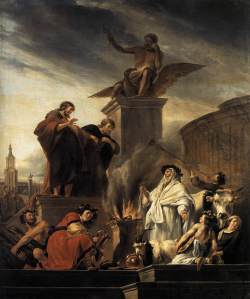
fansIn Acts 14, Paul and Barnabas have to fight off adoring fans. While preaching the Gospel with the city of Lystra, they healed a local cripple, sending the crowd into bedlam. The whispers-turned-to-shouts begin to revolve around a theory that the two missionaries are actually Zeus and Hermes mingling among humanity.

Paul and Barnabas were having none of it:

14 But when the apostles Barnabas and Paul heard of this, they tore their clothes and rushed out into the crowd, shouting: 15 “Men, why are you doing this? We too are only men, human like you. We are bringing you good news, telling you to turn from these worthless things to the living God, who made heaven and earth and sea and everything in them. 16 In the past, he let all nations go their own way. 17 Yet he has not left himself without testimony: He has shown kindness by giving you rain from heaven and crops in their seasons; he provides you with plenty of food and fills your hearts with joy.”

That last sentence recently grabbed my Advent-tuned mind.

Paul_and_Barnabas_at_Lystra_-_1650Paul and Barnabas credited God as the Maker and Manager of all things, who refuses to micromanage. Instead, they observed this Overseer allowing for freedom, while providing low-key, you-will-need-to-listen-carefully testimony of His constant presence.

According to non-Zeus and non-Hermes, one of the things that argues for God is joy.

This intrigues.

One of the classic lines of doubt in God’s existence springs from a simple theory: If evil is in the world, surely God is not.  The question here connects with every heart that has hurt. In times of pain, it springs so quickly that one has no chance to even assess its substance on its way out.

In the struggle to believe in a God who hasn’t already obliterated evil, some turn to a worldview that involves no deity at all.  We were not created; we evolved. There is no Plan; just the ones we make. Life, by its nature, is utilitarian. The strong (ie: useful, functional, advantageous) survive, whether you speak of traits or ideas or people.  To observe Darwin’s theory in moths changing colour is one thing; to extend his thoughts into an overarching interpretation of reality is another.

This is where one consideration demands more attention: What to do with fun? Beauty? Pleasure?

In a world void of any good and gracious Provider, in a world governed by “the strong survive”, how does one interpret joy?

In matters of God, airtight argument is like the Holy Grail. It’s longed-for, but the longer you seek it, the less you believe it exists. Knowledge of spiritual things requires a different processor than mere reasoning, much to my logic-loving chagrin. Gratefully, I have been kindly chided into confession that it is a very good thing that there is more going on than I can grasp.

In a world that I could entirely understand, nonsense like joy would have no place.

Loose ThreadNineteen centuries ago, Paul and Barnabas contended that joy was a loose strand, begging to be tugged on.

Give it a pull.

If you do, it will pull back.

Saturday Six-Pack (23)

Imagine: A “Saturday Six-Pack” arriving on… wait for it… Saturday!

After two weeks of lateness and a week of absence, I’ve regained my position on the top of the pile!

Here’s your weekly fodder of faith, ministry, and who-knows-what tossed in!

If you need help starting, begin with my two *Picks of the Week*, and move from there.

For a steady stream of such links, follow me on Twitter ( @JasonBandura ) to the right of this post.  Sharp quotes and solid articles are tweeted 3-4 times daily.

Today’s edition:

1) Why Churches Should Euthanize Small Groups
Being part of a leadership team that has significantly increased our emphasis on Small Groups in recent years, this title grabbed me.  Author and pastor Brian Jones points out a few of the struggles that many of us have experienced…

2) What Legalists and Atheists Cannot Understand (*PICK OF THE WEEK*)
This little piece from the Gospel Coalition revolves around a late night visit between Christian apologist Larry Alex Taunton, Oxford mathematician John Lennox and the late Christopher Hitchens, author of “God is Not Great”.  Throw in some rich references to my favourite portion of Scripture, and I freely recommend this one.

3) Fourteen Indispensable Leadership Quotes from Jim Collins
Jim Collins is recognized across the board as a voice of wisdom on the theme of leadership. Here, Thom Rainer captures a couple touchdowns’ worth of his best bits.

4) Why Women are More Religious than Men
For Psychology Today, Nigel Barber puts forth a theory that I confess to find quite weak. A strand of truth is here, but more than anything, this article served to enlighten me on why people of faith must live out their convictions or else risk observers like Mr. Barber largely missing the whole point.

5) You Are Not a Computer (Try as You May)
Here’s my favourite line from this great piece from the Harvard Business Review is this: “What information consumes is rather obvious. It consumes the attention of its recipients. Hence a wealth of information creates a poverty of attention.”  That opinion was shared in 1970, and it is abundantly on-the-mark today.  Some thought-provoking stuff here on how to live well within the “information age”.  If I had a third *PICK OF THE WEEK*, I’d put it here.

6) The Science of Productivity (*PICK OF THE WEEK*)
I just discovered Gregory Ciotti’s site: SparringMind.  This post features a three-minute video (which I tweeted a link to, earlier today) that breaks down some of the science behind our minds work and how we might better work within that framework to be more efficient in spending our time and energy. Quite fascinating to me!

May your week be full of awareness and enjoyment of the God who already fills it with Himself and every good thing.  Blessings on you, my friends.

YOUR TURN: Direct other readers to the best stuff with a comment below, or weigh in on what you read.  Your input makes this post better!

[You can subscribe to this blog via RSS or email, in the upper right corner of this page.]

When Your Doing is Your Undoing

This beloved portion of Scripture was part of this morning’s reading (1 Peter 1:3-4) :

3 His divine power has granted to us all things that pertain to life and godliness, through the knowledge of him who called us to his own glory and excellence, 4 by which he has granted to us his precious and very great promises, so that through them you may become partakers of the divine nature, having escaped from the corruption that is in the world because of sinful desire.

Many will tune out after the first major phrase: God gives us all we need.  Within itself, that is a wonderful truth, capable of fostering trust in God as the kind and capable Provider of all, to all.

However, Peter’s line of teaching goes a fair bit further.

Not only is God committed to providing life’s needs.  He is committed to making provision for each of us to journey into godliness, the state of God-likeness for which every human being has been designed.  To approach God is to open the door for Him to give you what you need for an existence of “glory and excellence”, even before we have any aspirations or desires for such a life.

The heavyweight phrase in this passage is undoubtedly “partakers of the divine nature”.  One could muse endlessly over the implications of such a five-word package.  But at least two points are clear:

  1. God has made outrageous promises that He intends to keep.
  2. These promises center upon delivering people into this form of existence: Partakers of the divine nature.

Then, in a clarifying statement, Peter expresses that one mark of this type of life is an escape from the corruption caused by sinful desires.  This corruption is in our world because it is in our hearts, and it is God’s intention on neither public nor private scales.  The one who knows anything about God will know this, and the one who values anything about God will make every move they can think of, in that direction.  This is where Peter’s list (faith, virtue, knowledge, self-control, steadfastness, godliness, brotherly affection, and love) finds its spot within the text: Pursue these qualities in your quest to experience both freedom and fruitfulness in Jesus Christ.

Efforts aside (and there are many to make), this escape from the dark and distorting desires of our hearts unfolds only as we:

  1. Embrace the promises of God (most call this “faith”).
  2. Seek to partake in the divine nature.

This second line matters greatly, as it speaks to the motivation behind every move we make.  Minus this motivation, we fall back into lesser motivations that actually undercut the transformation process:

  • Satisfaction in self, based upon some unwritten scoring system.
  • Reputation based on others’ perceptions of us or on inner illusions of ourselves.

Both of these can motivate us, but neither of them have anything to do with being freed from tainted desires.  In truth, both of them actually feed the corrupt (ie: Self-centered) tendencies that so easily sabotage our escape route into the God-designed life of “glory and excellence”.

“Make every effort”, to be sure.  But make them with measured focus, or our doing will actually be our undoing.

Grace is What Works

There is a pragmatist within each of us.

Bent toward the rational and the results,this inner dweller unintentionally opposes some of God’s most profound movements in our lives.

This logic-loving, get-the-job done approach to life, a staple of the Western society in which I’ve grown up, struggles to grasp the life-Creator, who strangely–yet frequently–insists on operating in “obviously” impractical ways.

Grace is the finest of examples.

The careful reader of the New Testament will quickly observe the inadequacy of human efforts toward salvation. However, that doesn’t stop us from trying! Bent on saving ourselves, proving ourselves, and sustaining ourselves, responsibility and duty–praiseworthy qualities within themselves–kick into hyper-gear.  In the process, pride awakens and pressure builds, all the while we are unaware that we are building brick walls between God’s salvation and our souls.

Legalistic tendencies seem wired into the human hardware.

The hymn-writer called grace “amazing”. We call it “unbelievable”. We may never use the word, but we feel incapable of grasping the concept, and embracing it feels even less likely.  That is the pragmatist within us, speaking with conviction: “Grace is impractical.”  You hear it in the push back we feel obliged to offer against grace, particularly religious or responsible citizens: “What about discipline? Grace alone is too soft; it won’t take people where they need to be. It takes more than grace to transform a life.”

Grace is not practical enough for our liking.

Or perhaps we are not nearly practical enough.

The dynamic at work here is something like John Piper describes in “Desiring God”, a book carrying the subtitle of “Meditations of a Christian Hedonist”. Piper argues that hedonism, the pursuit of pleasure, is an attitude built into the very human nature. Other than spiraling our souls into self-destruction, this pleasure-seeking drive is what drives the soul toward God.  Paradoxically, Piper suggests that the reason we get lost along the way is that we are not nearly hedonistic enough!  Settling for watered down forms of satisfaction, our pursuit of pleasure is revealed as too weak, rather than too strong. We chase happiness like slackers, at the expense of our souls.

C.S. Lewis was developing the same thought when he famously observed:

“It would seem that Our Lord finds our desires not too strong, but too weak. We are half-hearted creatures, fooling about with drink and sex and ambition when infinite joy is offered us, like an ignorant child who wants to go on making mud pies in a slum because he cannot imagine what is meant by the offer of a holiday at the sea. We are far too easily pleased.”

So back to where we began: We resist grace because it seems out-of-touch. “This won’t work in real life,” we critique.  Even more common might be the unspoken thought that Christ’s role in our lives is to provide a much-needed “reset” button. By his death and resurrection, he presses it and we sigh with relief.  We can take another kick at getting things right, in practical and reasonable ways, of course, powered by the fuel of self.

In this sense, we are part of a rich heritage of Christians who don’t get it.  Paul’s question to such folks:

Who has cast an evil spell on you? For the meaning of Jesus Christ’s death was made as clear to you as if you had seen a picture of his death on the cross. 2 Let me ask you this one question: Did you receive the Holy Spirit by obeying the law of Moses? Of course not! You received the Spirit because you believed the message you heard about Christ. 3 How foolish can you be? After starting your Christian lives in the Spirit, why are you now trying to become perfect by your own human effort? (Gal.3:1-3)

Beyond the Galatian goofballs, is anyone else’s “reset” button worn out from use?

“Seeking free-flowing forgiveness so we can take another futile kick at life on our terms”: Give me Impractical for $1000, Alex.

And there’s the rub.

Grace, in all its mystery and apparent irrationality, is the most practical of solutions to the human predicament.  The God we dismiss as idealistic or illogical actually, shock of shockers, knows what He’s doing, with His “power move” of offering freedom through surrender and victory through defeat.  Much to our surprise, perhaps chagrin, grace works.

In fact, it is only grace that works.

YOUR TURN: Why does humanity buck so hard against God’s grace?  What do you grasp about grace today that God has faithfully taught you over time?

Please leave your comment below, and enter the conversation.

[You can subscribe to this blog via RSS or email, in the upper right corner of this page. As well, follow me on Twitter ( @JasonBandura ) for 3-4 daily tweets daily of of insightful quotes or intriguing articles, sprinkled with occasional goofiness.]