Hope for the World

one wayOne facet of Christianity that rubs hard on many twenty-first-century minds is summed up tightly in this word: Exclusivity.

In a world of nearly infinite options, it seems unthinkable to some that one should feel “pigeon-holed” when it comes to the salvation.  And so we hang on the walls of our minds scenes of mountains with multiple paths of ascent or heavenly cloud-scapes reached by seven billion-plus uniquely crafted ladders.
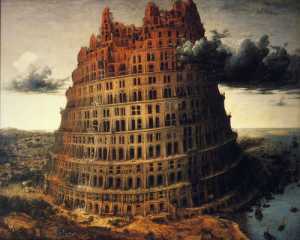
babelIn a sense, our hearts long for a return to the Tower of Babel, a design-as-you-wish blueprint that, if you are faithful in your efforts, will surely deliver you to whatever awaits “up there”.  “All roads lead to God” is the common tongue of every labourer on this scaffolding.

But as in Genesis 11, the word “gibberish” is quickly associated with this scenario.
vramachandraIn a twist on this discussion, Vinoth Ramathandra (a man to whom Timothy Keller introduced me) addresses an associated critique of Christianity, one that depicts religion as being dissociated from the “real world”, as being obsessed with the “spiritual” and out-of-touch, even inappropriately unconcerned, with the here-and-now world.

Ramathandra’s response will induce a pause for both hearty believers and hardened skeptics:

“Christian salvation lies not in an escape from this world but in the transformation of this world. You will not find hope for this physical world in any other religious system or philosophy. The biblical vision is unique.  And that is why if someone says, ‘Surely there is salvation in other faiths,’ I always ask them, ‘What salvation are you talking about?’

Not this salvation.

No faith holds out a promise of eternal salvation for the world like the cross and resurrection of Jesus Christ do.”

Christianity, if personified, is not the arrogant or presumptuous jerk that some portray, despite the fact that you may have met arrogant and presumptuous jerks with Bibles in hand.

Rather, Christian doctrine is unique by its very nature.  You can narrow your gaze on a concept like love or goodness, and then preach on the “common truth” that underlies all religions and philosophies, but you will only be adding to the static.  An observation like Ramathandra’s tunes in tighter to the signal and in turn, heightens the dialog.
HopeFor Christian fundamentalists, it highlights the care of God toward His current creation.  Unlike humanity, God is not always racing ahead to “what’s next”.  He deeply loves “what is” and is working for its redemption. For cynics of Christianity, such doctrine at least forces a reconsideration of the concept of hope.

What well do you draw yours from, not just for yourself but for the world in which you live?

Is there any?

Is it wrapped solely in the evolution and development of humanity? Strictly in scientific discovery? An alternative philosophy? A different religion?

YOUR TURN: What do you make of Ramathandra’s assessment of Christianity’s unique tone of hope for this world?  Christian or not, what are you striving to do/be as an agent of hope in our world?  Your input makes this post better!

[You can subscribe to this blog via RSS or email, in the upper right corner of this page.]

“Dad, What’s a Funeral?”

funeral flowersA few Sundays back, I was upgrading my wardrobe from the shirt and pants that I had worn to morning service to a full-blown suit and tie for an afternoon funeral. My four-year-old asked me why I was dressing up. I told her that I was going to a funeral, and in vintage four-year-old fashion, she asked the perfect question…

“Dad, what’s the funeral?”

Is it wrong that I wanted to provide her with a definition that made no mention of death, for fear of not knowing how to answer the next inevitable question?

Thoughts around mortality have rolled through my head more lately than usual.  Some of it is involvement in recent funerals. Some of it is the experience of raising small children and noting how very quickly time seems to pass.  The math doesn’t lie, nor do my joints.  Time is marching on.

Andrew Peterson, on his fantastic new album, says it this way:

And we just can’t get used to being here,
Where the ticking clock is loud and clear,
Children of eternity,
On the run from entropy.

Whatever the specifics, a couple observations linger:

1) Dust to dust is indeed the human reality, and my someday-dust-but-not-yet mind can hardly fathom the concept.  How can it be that friends I enjoyed only weeks ago can no longer exist in the form which I always enjoyed them?  We spoke and laughed and hugged, yet today, all physical traces of that speaking mouth, laughing voice, and embracing frame have vanished.  And my head shakes.

2) My struggle to grasp our own ends pushes me to consider the greater mystery of God’s endlessness.  The Bible portrays the reality that the my bookends of birth and death are merely tiny points upon the infinite shelf of God. Before me and after me, He is the sea in which my life floats.  As Scripture describes it, He goes before me and follows behind me, all the while His hand is upon me.

At times, the sting of death can seem very real.  It cuts through any veneer we have layered on.  It can unnerve us, even undo us.  Andrew Peterson’s lyrics above are affirmed as true: We do not know what to do with death, so much so that one wonders if our original design truly included this wretched feature.

pauseBut as we know, loss feels plenty real.  Sorrow can strike with staggering force.  There is no evading this enemy.  That said, perishing carries a unique perk.  This is why a friend of mine calls death “the great interrupter”.  Nothing hits the pause button as forcefully as death.  Assessments occur; inventory is taken.

In those painfully still moments, sometimes we step back from the canvas just enough to observe the frame on the painting.  And it is then that we observe that life–even in its dust-to-dust nature–is encompassed by One larger than the cosmos.

Surrounded by such loving grandeur, one can indeed walk through the valley of the shadow of death without fear.

YOUR TURN: How have/would you handle discussing death with kids? What have you learned from your run-ins with mortality? Your input makes this post better!

[You can subscribe to this blog via RSS or email, in the upper right corner of this page.]

Saturday Six-Pack (17)

Welcome to the weekend, a prime time for some “Wandering & Wondering”.

This weekend’s Six-Pack features a half-dozen of the best online bits I’ve read recently: About faith, about ministry, about who-knows-what.

If you need help prioritizing, note my two “Picks of the Week”, and roll on from there.

In this edition:

1) Winged Enemies
Each Sunday, Skye Jethani‘s four-year-old daughter warns the family, “We’re going to church. Watch out for poop.”  And with that introduction, I suggest you go read the rest of this article on spiritual warfare.

2) Risky Sex
Talk of “safe sex” is foolishness, according to Michael Hidalgo.  Even more, if it DID exist, who would want it?  Risky sex is where it’s at! **PICK OF THE WEEK**

3) Unequally Yoked
That is the new blog title of Leah Libresco, a prominent atheist blogger in some circles, who recently caused ripples with her post, “This is my last post for the Patheos Atheist Portal”.  In it, she briefly recounts her gradual conversion to Catholicism.  A summary by Scot McKnight can be read HERE, and Google can quickly provide you with more than a pile of responses and replies.

4) Why Smart People are Stupid
The New Yorker presented this piece on how your smartness may actually work against you.

5) It’s Not About the Dream
VeggieTales creator Phil Vischer turns to a jellyfish for new inspiration, new ventures, and a new way of doing business.  This is the story behind the man, behind Larry the Cucumber and Bob the Tomato, and it involves more convicting and repenting than you might expect.

6) Are You a Saint or a Scorpion
The memorable fable drives home a great point… or several! **PICK OF THE WEEK**

Enjoy your weekend, friends, through renewing yourself and reverencing God.

Saturday Six-Pack (12)

Welcome to the long weekend for my Canadian readers.  To those elsewhere, yours is surely coming before long!  Either way, it’s a pleasure to have you here for a bit of “Wandering & Wondering”.

Each week, the “Saturday Six-Pack” aims to share a half-dozen of the best online pieces I’ve read recently.  The majority of links lead to faith-focused or ministry-geared material, with the rest falling under the “disorderly pile of who-knows-what” tagline at the top of this page!

For today:

1) Spirit-Filled Living vs. Just Trying Harder
If you ever have the sense that the Christian life will require more than you have to give, you may be onto something.  Jim Cymbala is on to the same thought.

2) Does Suburbia Hurt Christianity?
Numerous churches speak of the quest to “live a life together”. But what if our everyday circumstances are sabotaging that goal? Then Relevant magazine writes an article about it!

3) The Lost Sin of Envy
Tim Challies challenges us to look inside ourselves, in search of the slippery sin of envy.

4) Why Bible Study Doesn’t Transform Us
Even this post’s title is provocative to this group sure-loving fellowship in which my faith has been birthed and nurtured. How could power possibly be lacking when people interact with God’s Word? Oh, there are numerous ways.

5)  The Idolatry of Individualism
The term “idolatry” is somewhat foreign to many Christians. It connotes images of gold-covered statues and flaky figurines.  We’re not so dumb as to let such things lead us away from the Eternal One.   But what about when the term is linked to one of our culture’s highest values?  That’s a tad less comfortable.

6) You Are Not a Computer (Try as You May)
Technology is meant to serve us. Instead it increasingly runs us — and runs us down.  Tony Schwarz of HBR brings these words of balance to how to live plugged-in without being sucked dry.

Have a great weekend, friends–renew yourself and reverence God.

Knowledge Without Power

A tragic misunderstanding exists.

This blurred vision drives people to regard Christianity as merely one more avenue toward high, idealistic morality to be shelved beside those of Plato, Socrates, Aristotle, Confucius, Buddha, Tao, and others. The name “Jesus” is simply added to the list of “History’s Great Teachers,” typically receiving a middle-of-the-pack position, surrounded by peers of superior and inferior status.

When Christianity is reduced to a moral path or ethical code, it becomes no more than a variant theme of “Goodness, Beauty, and Truth” to which many through the ages have aspired. Here is where the misunderstanding becomes glaring.

To hold Jesus primarily as a “goodness guru” will drive one to encourage, “Look to the example of Jesus.” But any sharp thinker quickly recognizes that there may be nothing in the world so discouraging as the example of Jesus. The immensity of his moral stature and the absoluteness of his perfection are despair-inducing. The very best of us stand hopelessly condemned before we set out. To speak of “imitating Christ” is the zany zenith of nonsense. I cannot satisfy my own standards. I am incapable of meeting my own demands, and I regularly disappoint others’. Imitate Christ?! This is the language of the lunatic.

Much of this is unsurprising: The extent of failure, both others’ and our own; the departures of some from Christian churches, and the perceived moral collapse in cultures around the globe. What else is expected when the ethical instruction of non-Christian sources or of neutered-Christian teaching builds squarely upon the strength and power that no human being possesses. The architect of such a blueprint can expect lawsuits.

Thank God the distortion is not the deal.

Christianity is no mere code of ethics. If this is the version of faith which you have perceived or received, I apologize for the pitiful counterfeit you have held, with either affection or affliction. Just as a forged fifty will net you nothing beyond disappointment or detention, a crap-copy of Christianity delivers disillusionment or worse.  Mark it down: When Christ gets counterfeited, people get cheated.

Numerous educators and influencers will turn to Christianity as a source for inspired instruction. They may come with guards up against anticipated narrow-mindedness, with minds inquiring, “Christians, what are your dearly held beliefs about life-factors like money, power, sex, and pride?”

The answer is that what I believe about money, power, sex, pride, or any host of other factors is of little consequence. My adding to the pile of perceived knowledge is not nearly so needed as the arrival of power sufficient to deliver men and women from the mastery and control of such things as these.

“It is not knowledge we need; it is power. And this is where your moral ethical systems break down and fail completely. They have no power to offer, none at all.”

WHAT’S YOUR TAKE? Join the conversation below.

What is your faith experience?
Do standards have center stage?
Has power been perceived?

A WORD: To any who read this post with disappointment, with realization that such power has never been perceived, let me plant a seed of hope in your heart.  It DOES exist.  The drudgery of duty is what killed the soul of the older brother (Luke 15).  This is not the destiny of those who are “in Christ”.  Seek your Father with your heart; He is eager to share His joy with you.

[These thoughts have been heavily reliant upon a piece, “On Romans 10:3”, written by David Martyn Lloyd-Jones in 1961. The title and closing quote are his. My offering is the internal interaction with his text, twisted into this post of assertive agreements and revived re-phrasings of his original sentiments.]