An Evening With Cosby

Several months ago, my wife bought me a birthday gift — a bucket-list-altering ticket to an event “some evening in the fall”.

Tonight is that evening, and it’s all tied back to a 2002 documentary.

Comedian-300x439Sometime after the end of his famous sitcom, Jerry Seinfeld was featured in a documentary called “Comedian”. It chronicled his journey, from sitcom star back to stand-up comedy. It provided anyone who cared a peek behind the curtain of what is involved in the creating and performing of a carefully crafted and painfully put-together stand-up act.  I found it fascinating.

Many of the best scenes feature Seinfeld in the back rooms of various comedy clubs, chatting with other known or lesser-known comics. They’re trying out jokes, analyzing what works and doesn’t, and shooting the breeze. Perhaps the best visit features Seinfeld and Chris Rock. The tone of the dialog suddenly changes; it gets slower, quieter.  They begin to speak of “someone”, someone whose comedy and career and character impresses them in an unusual way. They marvel at his longevity, at the fact that he had just performed what they thought was his greatest stuff yet. There is almost reverence in the scene, as they speak of Bill Cosby.

Bill-cosbyAnd that was when I made up my mind: I needed to see Cosby perform before one of us could no longer keep the appointment.

Tonight is that night, in Minot, ND.

Happy birthday, indeed!

Why Beavers are Better than Computers

Wily water-critters with their smacky tails, beavers can dam things.

Flashy control-centers with the wacky apps, computers can damn things worse.

Chunks of my past days have been spent trouble-shooting both my phone (Who knew IOS stood for “Your phone will become a paperweight”?) and my computer. The computer issue is not yet resolved, and it revolves around my Evernote application. I have nothing bad to say about Evernote, which is generally slick as can be. But my program seems to be locked up by a PDF I tried to upload on the weekend.  Multiple opens and closes have solved nothing. A re-load might be next.

Most of this is relevant to this blog only because I use Evernote to collect all my Six-Pack candidates.

And that’s why I’ve now missed a second edition of the struggling-to-be-weekly feature.

So I will continue to pound away at the Evernote elephant. And if that doesn’t work, I’m hiring out all my tech needs to beavers. If things are going to be this plugged up, there might as well be some buck-teethed furry fellows running the show.

Missing Six-Pack

MissingMy apologies on the absence of a Six-Pack this week. A three-day bathroom renovation, coupled with a Small Group Leaders Retreat at church dissolved large chunks of the past weekend.

But a new week has arrived, so the Six-Pack hunt is back at full speed.  If you have nominees for an upcoming Six-Pack, send them my way.  Together, we’ll put forth a special offering five days from now.

Grace and peace, my friends.

Life Beyond Ourselves (Part II)

Peter-on-waterIn my last post, I noted a connection between Peter’s walking on the water and a great typing groove.

At the moment that his feet felt his weight supported by the sea’s surface, Peter entered a supernatural experience. And for all of a few moments, he lived comfortably in a realm beyond himself. But it all ended as quickly as it began, and the unraveling began with something perfectly innocent and natural: some logical questions.

WHEN FINGERS > BRAINS

As I commented last time, typing at its finest involves fingers flying faster than brain waves. In that moment, the act of analyzing my movements is the wrecking ball that destroys the speed and ease. There’s nothing implicitly wrong with thinking – it’s just that there are realms beyond understanding, where mental clutching and grabbing snuffs out the beauty and power to which we’ve gained access.

In his later years, Peter wrote (perhaps even typed at break-neck speed 😉 ) that in Christ, we are invited to participate in the divine nature (2 Peter 1). He speaks explicitly of being freed from the corruption that saturates the fallen order. But I can’t help but wonder if his mind didn’t wander back to his brief taste of water-walking. Certainly, those were some participating-in-the-divine-nature moments! And surely he recalled the ease with which he lived in those moments.

Until he began to think.

And it was his very logical thoughts forming very reasonable questions that ended what he might have later labeled as the very normal expectation of Christ’s people: Participation in the divine nature — life beyond ourselves.

MORE THAN NATURAL

By grace, God invites us into a life far too big for ourselves. As children, our mothers bought us too-big clothing, assuring us that it was really just too-big-for-now clothing. The mom-mantra was spoken over us: “You’ll grow into it.”  And we came to know that, quite naturally, we would.

But grace is hardly natural.

To be sure, God calls us into a life too large for who we are. But unlike childhood clothing, there is no natural guarantee that we will grow into what He is giving.  In fact, left to our own soundest thoughts and stablest tendencies, we will wiggle ourselves out of it.  Our doubts will be well-founded, and our concerns will seem wisely-conservative — and they will do exactly what Peter came to learn: They will lead us from the supernatural to the natural. They will do away with “beyond ourselves”, in exchange for “within ourselves” — and we will feel the loss immediately.

We live in the afterglow of the Resurrection, the age in which the Spirit responsible for the original Creation hovers over the depths once again, eager to bring order and form to every life where faith awakens.  And within my spiritual schizophrenia , my gets-it self offers my frightfully-slow self a few words of counsel:

TRUST. And direct that trust toward God’s power before you direct it toward your ability to comprehend. Getting this backward creates a bottleneck in one’s spiritual life.

GRACE. God gives it freely, but be active in pleading for receptivity to this logic-defying gift. Any efforts to create formulas or square equations will be decimated by divine grace, so let them go.  Or you can do it after God breaks your calculator.

GRIP. Loosen it. None of us are big enough to be main characters in the grand Story. There is only One of those, and we find our wondrously appropriate identities solely in relation to Him. So breathe. And listen. And respond. God is good, and you are His.

YOUR TURN: How does Peter’s sea-standing experience speak to your life of faith? What have you learned about living, by grace, beyond yourself?

[You can subscribe to this blog via RSS or email, in the upper right corner of this page.]

Life Beyond Ourselves

In Matthew 14, Peter does the unthinkable. Faced with a potential phantom on the sea, Peter tests the apparent Jesus by daring, “If it’s really you, then call me out there with you.”

Peter-on-water“Come.”

The reasoning behind Peter’s request has long been lost on me. How much easier to test the “ghost” by quizzing him on last week’s accommodations are inviting him to do a secret handshake. However, such thoughts betray my ignorance of discipleship.

Within the relationship between Rabbi and disciple, there is always an aura of confidence. The Rabbi deeply believes that his disciples can become like him – they can do what he can do; they can be what he can be. Apparently, Peter has absorbed this sense of confidence, and it is worth noting that for all the criticism “doubting Peter” receives, there are eleven (or perhaps millions of) “believers” who are comfortably (and sadly) dry in their critiques.

THE TWIST

One fascinating twist on this story was recently revealed to me. It revolves around some simple questions: What exactly took place in those Peter-was-walking-but-now-he-isn’t moments? What actually happened out there?

Hints toward our answers lie in Jesus’ closing question to Peter: “Why did you doubt?”  We laugh at the apparently obvious answers: “How about we start with the wind and the waves, and we’ll go from there?” But weather reports are dwarfed by a basic recognition that we easily lose in the winds. Here it is.

Peter didn’t doubt Jesus.

Jesus’ feet were secure. He wasn’t sinking. He wasn’t even shaking. In fact, Peter’s cry for help is an easy indicator of his confidence in Jesus. On the verge of being sea-swallowed, there was only one name on Peter’s lips.  So, the just-below-the-surface realization here is that Peter was actually doubting himself. In the midst of a supernatural-saturated experience, some very natural thoughts arose — many of them seen clearly as one slides the emphasis through five small words:

How am I doing this?

How am I doing this?

How am I doing this?

How am I doing this?

How am I doing this?

Uncertainty crystallized into fear: “Oh man, I don’t think I can do this. There is no way I can do what my Rabbi does.”

For all the confidence that disciple-Peter might have earlier absorbed from his Master, more than Peter’s knees were shaking now.

FEET ON SEAS AND FINGERS ON KEYS

The whole story makes me think of typing.
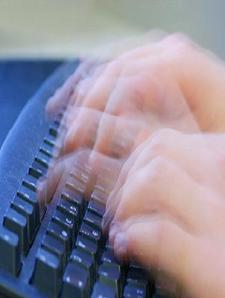
learn-how-to-type-fastI grew up on the border of technology, in that I actually had a typing class in high school. I remember it vividly because if you were quick enough to class, you found a seat at the luxurious electric typewriters. Pokier people got to build finger muscles by pounding the keys deep into the depths of their typewriters. Next door was the computer lab, whose machines held the reward for all of our digit-dancing devotion. All this to say: For all the skills my hands do not possess, they do type relatively well.

But here’s what amazes me about typing.

My hands can move significantly faster than my mind. To hit one’s keyboarding stride is a thing of beauty to the word-lover. It is a dance, in which ten small partners beat thoughts into text to a catchy clickety-clack rhythm.

Sometimes, in the midst of a great groove, I will catch myself thinking. “Wow, this is a great groove. My fingers are really flying!” And at about that moment, I slow down. I respond, in an attempt regain my footing in said groove, by consciously pushing harder and faster.  And the mistakes begin. Now I’m backspacing and grinding forward at a pace nothing like the earlier groove.  I was functioning on a level beyond thought, so much so that the act of thinking — typically a helpful act — actually serves as an anchor sinking me back down to a more average experience.

There is something profound here.

And I’ll tell you what it is… tomorrow.