A Year in the Scriptures

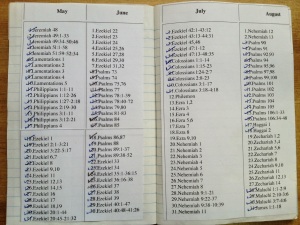
A year ago, I got myself organized by formatting our church’s Scripture reading schedule to fit neatly in my Bible cover. Below are three photos chronicling my success (and other things) in this venture:
20130101-094746.jpg

2012 Reading Schedule - Pic 22012 Reading Schedule - Pic 3A few observations may resonate with anyone who has ever tried to firmly establish a good habit:

1) Starting strong is admirable, but the real learning will take place miles from the gate you so eagerly burst forth from.

2) Life’s circumstances must be factored in. The birth of our third child, on May 28, and the rhythmic irregularities of summertime both had an obvious impact on my devotional habits.  “Creatures of habit” is sometimes tossed around as a derogatory term, but I view it as fact to be utilized wisely.  Craft the rhythms on which to build the habits, and you shape the creature you become. Do this wisely, but allow enough grace that you don’t despair when life’s special circumstances “interrupt”.

3) Reassessment and readjustment are key to ongoing success. Mid-November marked a conversation with my wife, in which we collectively planned how we desired to improve the scheduling patterns of our family life. The impact of those adjustments is obvious over the last six weeks of the calendar.

For any Christian – regardless of gender, age, or experience –  some form of Scripture diet is essential. I have never yet heard of a substantial spiritual life being cultivated apart from a love of Scripture.

A recent article by the Gospel Coalition offers five highly focused and practical tips toward developing one’s devotional habits.  If you have yet to settle upon a reading plan, do yourself a huge favour and choose one.  Numerous options can be found HERE or HERE.As well, you can view the Three Year Bible Reading Plan that our church uses. (We are just now entering year two of the cycle.)

If this habit is already well-established in your life, then you need little convincing to continue. If this habit is not yet established in your life, then today, this year, our gifts to you as entry points to the deeper realms of life available to all who seek God with all their hearts.

YOUR TURN: What have you discovered in your efforts to create Scripture and prayer rhythms in your life?  Any tips on what to do OR what not to do? Your input makes this post better!

[You can subscribe to this blog via RSS or email, in the upper right corner of this page.]

Loved Ones Love Well

Throughout the month of Advent, posts here have drawn from pieces submitted to the Glen Elm Church of Christ Advent Blog.  They have covered the four traditional themes of the season: Hope, Peace, Joy, and now Love.

In speaking of love, Scripture’s call to Christ’s followers is clear:

Be imitators of God, therefore, as dearly loved children and live a life of love, just as Christ loved us and gave himself up for us as a fragrant offering and sacrifice to God. (Ephesians 5:1-2)

The One who is love (1 John 4:16) tells the ones who are His, to mimic His ways. Revealed in Scripture as “gracious and compassionate, slow to anger and abounding in unfailing love”, this call to imitation is no light invitation.

How on earth could any of us live it out?

It is not that love is completely foreign to us. The vast majority of parents love their children without any nudging. Friends care for each other. Spouses cherish one another. The entire human race is said to bear the image of God, so it is hardly shocking that some “love genes” got passed from Father to children.

What is shocking though is how quickly love mutates into something less than divine.  And it is ME that taints the mixture. I don’t even mean that I add something that ruins the recipe. I mean that I am the something that taints the recipe.

And you do the same.

Well-intentioned and seeking the good, we march into St. Paul’s call. We will be “imitators of God”; we will “live a life of love”. With all the power in us, we will pursue this most holy call.

And we fail miserably, injuring others and ourselves in the process.  Our noblest efforts are undercut by insecurities that we mask and independence that we magnify.  Our hearts may long to love well, but our hearts are fragmented at best.  And when did something fractured ever show sufficient strength to live up to its billing?

No, if we are to be imitators of the love-God, it will require more than the powered housed within us.

A re-reading of the fine print in Ephesians 5:1-2 may make all the difference:

Be imitators of God, therefore, as dearly loved children and live a life of love, just as Christ loved us and gave himself up for us as a fragrant offering and sacrifice to God. (Ephesians 5:1-2)

There is one prerequisite to following God’s love-call with any measure of faithfulness; it is non-negotiable. No other credits will transfer in.  It is not that God is a stickler for details; it is simply that we cannot run before we walk.

Ahead of being loving, you must be loved.

Prior to imitating God’s loving ways, you must have felt God’s loving ways.

The topic of embracing, by faith, the love of God, even as it embraces us, could be the subject of a thousand posts.  (Perhaps this will serve as the first.)  But the conversation started here today is simply an affirmation that Paul knew of what he spoke: You cannot give what you do not have.

And if you do not have, it is not because the Being known as Love is holding back.

If even a sliver of suspicion has awakened within you, that a touch of God’s love might change life as you know it, seek Him in as exposed and trusting posture as you can strike and speak with those around you who appear to be living as “dearly loved children”.

I mean, who could dish out higher quality love than those called God’s “dearly loved children”?!

YOUR TURN: What barriers have you experienced in “moving into” the love of God? What advice would you offer someone who was seeking to feel more like a “dearly loved child”?  Your input makes this post better!

[You can subscribe to this blog via RSS or email, in the upper right corner of this page.]

Peace for A Purpose

Slide1As I mentioned in an earlier postour church has created an Advent Blog each December for last few years.  Articles and reflections are submitted by members and friends of our congregation, on a variety of topics tied to the Advent season.  You are most welcome to join us in this annual pilgrimage toward Christmas.

My first submission was on HOPE.  This one is on PEACE.

[ABOUT THE AUTHOR: Jason Bandura works with the Glen Elm Church of  Christ.  Married to Shannon, he is Dad to three lovely daughters.  He lives on the Canadian prairies and writes occasionally HERE.]

Everyone craves peace.

We pray it for our nations and households. We seek it for our world and for our minds. The whole of humanity could sing together of the desire for a “peaceful, easy feeling”

If it ever arrived, what would we do with it?

The Old Testament prophet Malachi described a beautiful covenant that God had established with Levi, a figure from centuries earlier:

“My covenant was with him, a covenant of life and peace, and I gave them to him; this called for reverence and he revered me and stood in awe of my name. True instruction was in his mouth and nothing false was found on his lips. He walked with me in peace and uprightness, and turned many from sin.

“For the lips of a priest ought to preserve knowledge, and from his mouth men should seek instruction—because he is the messenger of the Lord Almighty.”

Levi, the namesake for Israel’s priestly tribe (the Levites) enjoyed a covenant with Yahweh, described as one “of life and peace”. Levi lived reverently, and in exchange, his life was empowered to influence others toward a similar way of life and peace.

The priests were to experience Yahweh’s peace. Why?

So that they could bless the tribes around them.

Picked up in the New Testament, priestly imagery gets attached to the followers of Jesus, who are identified as a “royal priesthood”, apparently called to fill the role of representatives between heaven and humanity. (This concept is observed in the common Protestant doctrine of the “priesthood of all believers”.)

We see the establishing of this role in John 20:

19 On the evening of that first day of the week, when the disciples were together, with the doors locked for fear of the Jews, Jesus came and stood among them and said, “Peace be with you!” 20 After he said this, he showed them his hands and side. The disciples were overjoyed when they saw the Lord.

21 Again Jesus said, “Peace be with you! As the Father has sent me, I am sending you.” 22 And with that he breathed on them and said, “Receive the Holy Spirit. 23 If you forgive anyone his sins, they are forgiven; if you do not forgive them, they are not forgiven.”

24 Now Thomas (called Didymus), one of the Twelve, was not with the disciples when Jesus came. 25 So the other disciples told him, “We have seen the Lord!”

But he said to them, “Unless I see the nail marks in his hands and put my finger where the nails were, and put my hand into his side, I will not believe it.”

26 A week later his disciples were in the house again, and Thomas was with them. Though the doors were locked, Jesus came and stood among them and said, “Peace be with you!”

To disciples locked away in fear that Jesus’ killers would soon hunt them down too, Jesus first spoke, “Peace.” Displaying himself as alive and victorious, he spoke the word again.  Having shared his peace with them, he now sent them into their world in the same manner that God has sent him into ours.  They received peace so that they might go into the world as representatives of the wholeness—the Shalom—that God is working to re-establish in His creation, one life at a time.

Poor Thomas misses this empowering experience.  But a week later, Jesus grants him the wound-examination he craves, after offering one key word of comfort: “Peace.”  We dare to see the same sending trajectory being established, even with the one famously called “doubting Thomas”.

How about Chennai, India?

Strong strands of tradition locate Thomas taking the Gospel of Jesus to the Indian sub-continent, as his response to Christ’s peace-sharing work in his life.

Apparently, tasting of God’s peace is a powerful enough experience to drive even an infamous doubter into offering himself as a Shalom-ambassador, at the exclusive disposal of the Infinite One.

Make no mistake: God wants to give you peace.

Just be sure you know why He wants to grant you such a gift.  You can be sure it is a grander design than a few more Z’s tonight.

When the Invisible One Makes Things Visible

In Daniel 2, a deadly decree was issued.  The wise men of Babylon were collectively condemned and sentenced to death for their perceived failure to faithfully serve the king, Nebuchadnezzar.

Their shortcoming?

Dream of NebuchadnezzarThey were unable to make sense of the king’s troubling dreams.  But even that isn’t the whole story.  In a mistrust-motivated move, Nebuchadnezzar demanded that these sages do their work “blindfolded”–he would not tell them the content of the dream.  They were to provide him with both the material and the meaning.

Daniel learned all this, only once the arrest warrant was already at his door.  Requesting time to pray, he and his faithful friends–Hananiah, Mishael, and Azariah–sought revelation from the God of heaven.

How would you prayer go if your life depended upon receiving an answer you could not begin to dream up?  (The next question might be: What keeps you from always praying with that sense? But that’s another post.)

Daniel and his friends pleaded for nothing less than divine revelation. And it was received!

Their rightful response:

“Blessed be the name of God forever and ever,to whom belong wisdom and might.

He changes times and seasons; he removes kings and sets up kings; he gives wisdom to the wise and knowledge to those who have understanding; he reveals deep and hidden things; he knows what is in the darkness, and the light dwells with him. 

To you, O God of my fathers, I give thanks and praise, for you have given me wisdom and might, and have now made known to me what we asked of you,for you have made known to us the king’s matter.” (Daniel 2:20-23)

God’s role as Revealer is wondrous!  My experiences with revelation–albeit not exactly of visions interpreted–have astounded me in a couple ways:

  1. God’s provision is precise.

    Both timely and measured, divine revelation is not unlike the message Neo receives from the Oracle, in the Matrix.  On one level, it appears inadequate and inconsequential, even unhelpful.  On another level, it is exactly–and not a hair more–what he needs to take his next step.

  2. God’s means are many.

    A friend’s words, a Scripture message, song lyrics, movie lines, and more–sometimes it’s actual words expressed, other times the truth is found in the spaces between those words.  But the Living God has no need of language either.  To me, He has also revealed through insights I could not generate, emotions I could not ignore, dreams I could not forget, and circumstances I could not concoct.

And every experience of revelation leads one into a Daniel-mode of worship, though seldom so vividly verbalized, for who cannot enter a mode of wonder at a One who knows all things and shares them succinctly yet shockingly when we seek Him?

enlightenment

Revelation is one of the wonders of the Christian experience, undeniable and unexplainable, a glorious form of spiritual feeding.

Those moments of seeing are a most beautiful thrill in one’s walk with the Unseen One.

Blessed be the name of God forever and ever,to whom belong wisdom and might.

Grace is What Works

There is a pragmatist within each of us.

Bent toward the rational and the results,this inner dweller unintentionally opposes some of God’s most profound movements in our lives.

This logic-loving, get-the-job done approach to life, a staple of the Western society in which I’ve grown up, struggles to grasp the life-Creator, who strangely–yet frequently–insists on operating in “obviously” impractical ways.

Grace is the finest of examples.

The careful reader of the New Testament will quickly observe the inadequacy of human efforts toward salvation. However, that doesn’t stop us from trying! Bent on saving ourselves, proving ourselves, and sustaining ourselves, responsibility and duty–praiseworthy qualities within themselves–kick into hyper-gear.  In the process, pride awakens and pressure builds, all the while we are unaware that we are building brick walls between God’s salvation and our souls.

Legalistic tendencies seem wired into the human hardware.

The hymn-writer called grace “amazing”. We call it “unbelievable”. We may never use the word, but we feel incapable of grasping the concept, and embracing it feels even less likely.  That is the pragmatist within us, speaking with conviction: “Grace is impractical.”  You hear it in the push back we feel obliged to offer against grace, particularly religious or responsible citizens: “What about discipline? Grace alone is too soft; it won’t take people where they need to be. It takes more than grace to transform a life.”

Grace is not practical enough for our liking.

Or perhaps we are not nearly practical enough.

The dynamic at work here is something like John Piper describes in “Desiring God”, a book carrying the subtitle of “Meditations of a Christian Hedonist”. Piper argues that hedonism, the pursuit of pleasure, is an attitude built into the very human nature. Other than spiraling our souls into self-destruction, this pleasure-seeking drive is what drives the soul toward God.  Paradoxically, Piper suggests that the reason we get lost along the way is that we are not nearly hedonistic enough!  Settling for watered down forms of satisfaction, our pursuit of pleasure is revealed as too weak, rather than too strong. We chase happiness like slackers, at the expense of our souls.

C.S. Lewis was developing the same thought when he famously observed:

“It would seem that Our Lord finds our desires not too strong, but too weak. We are half-hearted creatures, fooling about with drink and sex and ambition when infinite joy is offered us, like an ignorant child who wants to go on making mud pies in a slum because he cannot imagine what is meant by the offer of a holiday at the sea. We are far too easily pleased.”

So back to where we began: We resist grace because it seems out-of-touch. “This won’t work in real life,” we critique.  Even more common might be the unspoken thought that Christ’s role in our lives is to provide a much-needed “reset” button. By his death and resurrection, he presses it and we sigh with relief.  We can take another kick at getting things right, in practical and reasonable ways, of course, powered by the fuel of self.

In this sense, we are part of a rich heritage of Christians who don’t get it.  Paul’s question to such folks:

Who has cast an evil spell on you? For the meaning of Jesus Christ’s death was made as clear to you as if you had seen a picture of his death on the cross. 2 Let me ask you this one question: Did you receive the Holy Spirit by obeying the law of Moses? Of course not! You received the Spirit because you believed the message you heard about Christ. 3 How foolish can you be? After starting your Christian lives in the Spirit, why are you now trying to become perfect by your own human effort? (Gal.3:1-3)

Beyond the Galatian goofballs, is anyone else’s “reset” button worn out from use?

“Seeking free-flowing forgiveness so we can take another futile kick at life on our terms”: Give me Impractical for $1000, Alex.

And there’s the rub.

Grace, in all its mystery and apparent irrationality, is the most practical of solutions to the human predicament.  The God we dismiss as idealistic or illogical actually, shock of shockers, knows what He’s doing, with His “power move” of offering freedom through surrender and victory through defeat.  Much to our surprise, perhaps chagrin, grace works.

In fact, it is only grace that works.

YOUR TURN: Why does humanity buck so hard against God’s grace?  What do you grasp about grace today that God has faithfully taught you over time?

Please leave your comment below, and enter the conversation.

[You can subscribe to this blog via RSS or email, in the upper right corner of this page. As well, follow me on Twitter ( @JasonBandura ) for 3-4 daily tweets daily of of insightful quotes or intriguing articles, sprinkled with occasional goofiness.]