You Can Make Jesus Marvel!

It’s all been done; that’s what we are told.

And most days, we believe it.

Living in an age of accessible information and technological wonder, placed in a society of privilege and plenty, we are slow to be shocked. Skeptical and cynical, we salt everything. Amazement is nearly an extinct response, as extreme entertainment and non-stop stimulation have stolen such wonder from us.

Surely Jesus, one who had tasted heaven’s glory firsthand felt some such struggle as well.  Yet Luke 7 tells us of an incident that made Jesus marvel.

CenturionThe chapter opens with story of a Roman centurion. One of his dear servants was deathly ill. Having heard rumblings of a wonder-worker named Jesus, the centurion asked the Jewish elders of his community to approach the healer on his behalf. The Jews were quick to respond, as the Roman had constructed their local synagogue in a display of his affection toward the Jewish people and their way of life.

Jesus agreed to come.

But as he neared the house, he was intercepted by friends of the centurion. They carried a simple message: “Do not trouble yourself in coming, for I am not worthy to have you in my home. This is why I did not presume to come myself. Rather, say the word and healing will take place. I know how authority works as I serve under leaders, and soldiers serve under me. Commands are given, and action is executed. Please wield your power kindly toward me and my servant.”

And this made Jesus marvel.

One can almost imagine him stopping in stride. Smiling a sly grin and slightly shaking his head as he closed his eyes.

This was understanding. This profession of faith, from an outsider nonetheless, was profoundly insightful.

It carried conviction that Jesus was more than a tricky physician, who healed the insides by touching the outside. Rather this declaration professed a belief that Jesus was a spiritual power-broker, a mover and a shaker in the invisible realms. Every type spirit and force knelt before him, and a domain existed–even here and now–where his command was beyond question.

The centurion foresaw an answer to the prayer, “May Your kingdom come and Your will be done on earth as in heaven.” He could see that such a kingdom was already at hand, and he was pleading humbly and honorably with Jesus to let it break into his life in great and gracious ways.

I want to make Jesus marvel just like that.

Lent is a Wilderness Season

Early in Luke’s gospel, he details the rise of John the Baptist’s public ministry.  His third chapter begins by rooting John in time by surrounding him with the “vital statistics” of his day:

1 In the fifteenth year of the reign of Tiberius Caesar, Pontius Pilate being governor of Judea, and Herod being tetrarch of Galilee, and his brother Philip tetrarch of the region of Ituraea and Trachonitis, and Lysanias tetrarch of Abilene, during the high priesthood of Annas and Caiaphas, the word of God came to John the son of Zechariah in the wilderness. And he went into all the region around the Jordan, proclaiming a baptism of repentance for the forgiveness of sins.

Most of these names mean little to today’s reader; most of these places are unknown. But in John’s (and Jesus’) day, these were the high rollers in the power centers. These were the figures writing the rules and making the waves.

And fascinatingly, God uses them as the background music for the scene that He is unfolding.

Into this time and place, God’s word arrived.

His message would inaugurate His move. And that word was delivered to a no-man in the no-man’s land: John in the wilderness.

Judean Wilderness

The wilderness of Scripture is the academy of the saints.

It was the scene of Moses’ leadership course in Midian, as Yahweh transformed an angry murderer into a surrendered deliverer. It was the venue for Israel’s forty-year shaping, which cost them an entire generation, on how to live as freed people in the Promised Land. It was also the setting for Jesus to be tested by the Adversary, ahead of his public ministry.

Luke depicts John the Baptist, also in the wilderness, seeking and listening.  The human eye can quickly glaze over at the vastness and blankness of the wilderness, and one small man in its midst can seem like dust.

Yet Luke, having sketched all the people and places where logic might expect Divinity to deliver His message, is explicit that this word is addressed to the simple one in the silent place: “The word of God came to John the son of Zechariah in the wilderness.”

Lent is a wilderness season.

It drives us into modes of reflection and recounting. We agree with God on the terms of full access that He might search us and freely reveal—even rebuke—whatever that He finds.  The wilderness, by its nature, is a refining environment. It swallows those who ill-equipped to dwell there. It silently pushes people toward precipices, where survival is uncertain.

Lent, by its nature, is the seeking of such an environment.  As did John, we place ourselves in a wilderness setting—via fasting or forgiving, reflecting or repenting—because we know that people who are at the ends of themselves, dwelling on the ends of the earth, are often those upon whom the life-giving word of God falls first.

Wearing the Surprising Yoke of Christ

This invitation is among Jesus’ most famous words (Mt 11:28-30):

“Come to me, all who labor and are heavy-laden, and I will give you rest. Take my yoke upon you, and learn from me, for I am gentle and lowly in heart, and you will find rest for your souls. For my yoke is easy, and my burden is light.”

YokeTillers International put out a document on how to build a yoke (in case you were looking for a wood shop project).  They noted that a typical wooden yoke might weigh 50-60 pounds, certainly more than I’d care to carry in a backpack each day but hardly problematic to a team of animals who might weigh a couple tons collectively.

That got me to thinking about the yoke Jesus offers.

He says that it will not feel burdensome. He also says that wearing it will be a form of learning.

Here is where the image surprises.

Yoke-talk was common-place among first-century rabbis. It spoke of whose rule one was living out, whose Torah-interpretation one was holding, whose “way” one was walking.  Typically, potential students might approach a teacher under whom they desired to learn.  Some sort of “application” would take place, with testing and gauging of whether this student was suitable for this master.  Jesus splits from the standard operating procedures immediately by putting out a call of invitation, particularly to those whose current yokes are crushing them. To the wearied and the worn, a restful yoke awaits.

How can it be so?

I mean, Jesus is the same one who called his followers to “be holy, as God is holy”. He told them that they would need to pursue a higher form of righteousness than the minutia-minded Sinai-sticklers of their day, so we can safely conclude that he was not speaking of slack standards or halfway holiness.

Perhaps the clue lies in the imagery of the yoke.

Yoke-Jesus-Matthew-11-28-30-300x225Picture it.

See the metaphor: View the farm, hear the livestock, assess the fields to work.

Imagine it.

Place yourself there: Smell the dirt, breathe the air, feel the weight of a yoke.

At this moment, where is Jesus?

If there is a yoke and we are wearing it, then it seems easy enough to assess our spot in the sketch. We are the beast of burden, ready to plow under the watch of a master. Simple enough.

But where is Jesus?

That seems easy too.

I mean, if he’s the owner of the yoke, then he is the farmer, intent on training us to be obedient and useful to himself.  Every facet of that metaphor works for standard Christian teaching.

However, I cannot help but wonder if we’re missing a key–a very key–detail.

Farmer with working elephant. IndiaYears ago, my wife and I spent time in southeast Asia. At a number of spots, we encountered elephants: We rode some, we fed some, we visited reserves and protection programs.  We also witnessed elephants being used as work-animals. Be assured, you can get some stuff done with an elephant! Who needs horsepower when you’ve got elephant power and a trunk?!

One of the trainers said that when they’re working with a new elephant, they match him up with their best elephant. The rookie gets yoked alongside the expert. He gets mastered; he gets discipled.

And that is what I think we’re missing when we read Matthew 11.

It makes all kinds of sense to see Jesus as the yoke-owning, beast-breaking farmer.

Perhaps it makes all kinds of more sense to see Jesus as the yoke-sharing, way-walking beast beside us.

He straps us to himself and shows us how to walk.  Like stubborn elephants, we pull against and jostle with the yoke and the partner. And like the steady guide, he holds the line, graciously allowing us to learn and adjust. When pride breaks and rebellion subsides, we discover that we can sync our strides to this steady companion.

And in that moment of coordination and partnership, we discover that we don’t even notice the yoke upon us.  The load is shared, and truth be told, he is bearing the weight so completely that our portion merits no mention.  Beyond that, we begin to realize that a life of satisfying fruitfulness has begun.

Welcome to the life of the disciple!

Worry Results from Allowing Fear to Imagine the Invisible

worryWe all know there’s no value in worrying.

If a parent or teacher failed to personally tell us, voices throughout history are eager to chime in:

“Worry is interest paid on trouble before it comes due.” (William Ralph Inge)

“Worry does not empty tomorrow of its sorrow. It empties today of its strength.” (Corrie ten Boom)

“Pray, and let God worry.” (Martin Luther)

“There is nothing that wastes the body like worry, and one who has any faith in God should be ashamed to worry about anything whatsoever.” (Mahatma Gandhi)

Yet for all the persuasive voices speaking all the compelling words, worry takes hold on our souls.  What counter-move might we make against its persistent grip?

Charles Swindoll has offered this perspective:

“On the day Jesus was crucified, it would have appeared to anyone seeing through eyes of flesh that the darkness, the devil, and death had defeated the Son of God once and for all. I will admit that those three D’s lie at the root of almost every worry I suffer. I worry about DEATH – in particular, the death of the people I love. I worry about DARKNESS, both literal and figurative. I worry about what the DEVIL is up to. All three worked diligently throughout the ministry of Jesus to bring about this long and anguishing day. But what no one could see was that the Messiah’s death would strike at the very heart of evil.”

Worry results from allowing fear to imagine the invisible.

To be sure, there will always be an invisible realms–questions without answers, ventures without guarantees. Life, by its nature, is filled with blanks.

But the message of Scripture is that much of that space is filled by a God whose very nature is gracious and compassionate, slow to become angry and abounding in steadfast love.  Seen most vividly in Jesus’ death and resurrection, we are dared to rein in our ability to quickly imagine the worst, in exchange for a freedom to steadily believe the best.

The Bible’s opening scene depicts a God of light that dwells in the darkness and a God of order than hovers over the chaos.  As Swindoll said above, these lessons were re-affirmed for all time in what we thought were the darkest moments of all.

As God says numerous times in Scripture, “Do not be afraid, for I am with you.”

And He is.

Even more than you would believe!

YOUR TURN: How do you handle fear?  In what ways has your faith impacted your tendencies toward worry?  YOUR COMMENTS MAKE THIS POST BETTER.

[You can subscribe to this blog via RSS or email, in the upper right corner of this page.]

A Year in the Scriptures

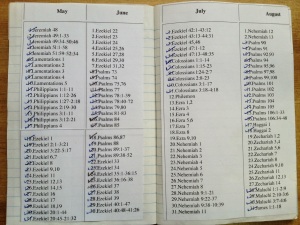
A year ago, I got myself organized by formatting our church’s Scripture reading schedule to fit neatly in my Bible cover. Below are three photos chronicling my success (and other things) in this venture:
20130101-094746.jpg

2012 Reading Schedule - Pic 22012 Reading Schedule - Pic 3A few observations may resonate with anyone who has ever tried to firmly establish a good habit:

1) Starting strong is admirable, but the real learning will take place miles from the gate you so eagerly burst forth from.

2) Life’s circumstances must be factored in. The birth of our third child, on May 28, and the rhythmic irregularities of summertime both had an obvious impact on my devotional habits.  “Creatures of habit” is sometimes tossed around as a derogatory term, but I view it as fact to be utilized wisely.  Craft the rhythms on which to build the habits, and you shape the creature you become. Do this wisely, but allow enough grace that you don’t despair when life’s special circumstances “interrupt”.

3) Reassessment and readjustment are key to ongoing success. Mid-November marked a conversation with my wife, in which we collectively planned how we desired to improve the scheduling patterns of our family life. The impact of those adjustments is obvious over the last six weeks of the calendar.

For any Christian – regardless of gender, age, or experience –  some form of Scripture diet is essential. I have never yet heard of a substantial spiritual life being cultivated apart from a love of Scripture.

A recent article by the Gospel Coalition offers five highly focused and practical tips toward developing one’s devotional habits.  If you have yet to settle upon a reading plan, do yourself a huge favour and choose one.  Numerous options can be found HERE or HERE.As well, you can view the Three Year Bible Reading Plan that our church uses. (We are just now entering year two of the cycle.)

If this habit is already well-established in your life, then you need little convincing to continue. If this habit is not yet established in your life, then today, this year, our gifts to you as entry points to the deeper realms of life available to all who seek God with all their hearts.

YOUR TURN: What have you discovered in your efforts to create Scripture and prayer rhythms in your life?  Any tips on what to do OR what not to do? Your input makes this post better!

[You can subscribe to this blog via RSS or email, in the upper right corner of this page.]