Worry Results from Allowing Fear to Imagine the Invisible

worryWe all know there’s no value in worrying.

If a parent or teacher failed to personally tell us, voices throughout history are eager to chime in:

“Worry is interest paid on trouble before it comes due.” (William Ralph Inge)

“Worry does not empty tomorrow of its sorrow. It empties today of its strength.” (Corrie ten Boom)

“Pray, and let God worry.” (Martin Luther)

“There is nothing that wastes the body like worry, and one who has any faith in God should be ashamed to worry about anything whatsoever.” (Mahatma Gandhi)

Yet for all the persuasive voices speaking all the compelling words, worry takes hold on our souls.  What counter-move might we make against its persistent grip?

Charles Swindoll has offered this perspective:

“On the day Jesus was crucified, it would have appeared to anyone seeing through eyes of flesh that the darkness, the devil, and death had defeated the Son of God once and for all. I will admit that those three D’s lie at the root of almost every worry I suffer. I worry about DEATH – in particular, the death of the people I love. I worry about DARKNESS, both literal and figurative. I worry about what the DEVIL is up to. All three worked diligently throughout the ministry of Jesus to bring about this long and anguishing day. But what no one could see was that the Messiah’s death would strike at the very heart of evil.”

Worry results from allowing fear to imagine the invisible.

To be sure, there will always be an invisible realms–questions without answers, ventures without guarantees. Life, by its nature, is filled with blanks.

But the message of Scripture is that much of that space is filled by a God whose very nature is gracious and compassionate, slow to become angry and abounding in steadfast love.  Seen most vividly in Jesus’ death and resurrection, we are dared to rein in our ability to quickly imagine the worst, in exchange for a freedom to steadily believe the best.

The Bible’s opening scene depicts a God of light that dwells in the darkness and a God of order than hovers over the chaos.  As Swindoll said above, these lessons were re-affirmed for all time in what we thought were the darkest moments of all.

As God says numerous times in Scripture, “Do not be afraid, for I am with you.”

And He is.

Even more than you would believe!

YOUR TURN: How do you handle fear?  In what ways has your faith impacted your tendencies toward worry?  YOUR COMMENTS MAKE THIS POST BETTER.

[You can subscribe to this blog via RSS or email, in the upper right corner of this page.]

For Those Who Crave Peace

Our view of peace is too small.

peaceWe crave a stillness, a calm where no ripples disrupt.  Something inside us says that this is the goal of life, to arrive at this state: Where nothing further needs doing, where no further climbing remains. Labourers dream of retirement, travelers long for arrival, tomorrow’s promise pulls us through today’s pressure.

In 1658, Miguel de Molinos published a piece entitled, “Spiritual Guide Which Disentangles the Soul”. This Spanish priest eloquently expressed a fundamental task awaiting any who desire God:

“You ought to know that your soul is the center, habitation, and the kingdom of God. That therefore, in order that the sovereign King may rest on the throne of your soul, you should take pains to keep it clean, quiet, void, and peaceable; clean from guilt and defects; quiet from fears; void of sinful affections, desires, and thoughts; and peaceable in temptations and tribulations.”

This advice is hardly rocket science.

Yet it is critically necessary in any pursuit after spiritual vitality.

However, Molinos was aware of the struggle involved in this pursuit, of the failure that we will all taste in the caring for our souls.  To every seeker of God, he goes on to offer these words of comfort:

“Do not be upset or discouraged if you feel fainthearted, for He will return to quiet you, that He may still stir your heart. This divine Lord will fill you and rest in your soul, forming a rich throne of peace. He does this by means of internal recollection and through His heavenly grace, so that within your own heart, you may look for silence in the tumult, solitude in the crowd, light in the darkness, forgetfulness in trials, strength in weakness, courage in fear, resistance in the midst of temptation, peace in war, and quiet in tribulation.”

It is wondrous to consider that God is eager to remain and to reign within our deepest dimensions, spaces which we so struggle to dedicate to Him. Yet He works to grant us some measure of peace. Why? So that He might stir us.

There is a wonderful paradox here.

In our lives, the One who stills one storm is often the same One who summons the succeeding tremors. The One who rescues us from the fire ignites within us a greater blaze than any other. The One who frees us from life-stealing, low-level loves goes on to call us to love Him with a consuming affection.

“For he will return to quiet you, that he may still stir your heart.”

Seek peace for your souls today, friends.  Pursue it in every god-honouring way you can think of.  But do so with an awareness that God will grant it to you with the attached intention of forcefully stirring your heart.

Apparently, our view of peace is too small.

So go ahead and seek it today.  But seek peace with an awareness that the God who grants it will undoubtedly still your soul so that He might stir it mightily!

YOUR TURN: How have you pursued a peaceful soul? Have you a story of how God provided the peace you desired? YOUR COMMENTS MAKE THIS POST BETTER.

[You can subscribe to this blog via RSS or email, in the upper right corner of this page.]

The Giver of Joy

The 2013 Advent Blog that my church is hosting continues to run.  Here was my recent post on the topic of JOY:

[ABOUT THE AUTHOR: Jason Bandura works with the Glen Elm Church of  Christ.  Married to Shannon, he is Dad to three lovely daughters.  He lives on the Canadian prairies and writes occasionally HERE.]

Is this an early Christian mission OR one of pop music’s teen idols battling for survival?

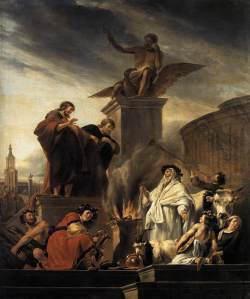
fansIn Acts 14, Paul and Barnabas have to fight off adoring fans. While preaching the Gospel with the city of Lystra, they healed a local cripple, sending the crowd into bedlam. The whispers-turned-to-shouts begin to revolve around a theory that the two missionaries are actually Zeus and Hermes mingling among humanity.

Paul and Barnabas were having none of it:

14 But when the apostles Barnabas and Paul heard of this, they tore their clothes and rushed out into the crowd, shouting: 15 “Men, why are you doing this? We too are only men, human like you. We are bringing you good news, telling you to turn from these worthless things to the living God, who made heaven and earth and sea and everything in them. 16 In the past, he let all nations go their own way. 17 Yet he has not left himself without testimony: He has shown kindness by giving you rain from heaven and crops in their seasons; he provides you with plenty of food and fills your hearts with joy.”

That last sentence recently grabbed my Advent-tuned mind.

Paul_and_Barnabas_at_Lystra_-_1650Paul and Barnabas credited God as the Maker and Manager of all things, who refuses to micromanage. Instead, they observed this Overseer allowing for freedom, while providing low-key, you-will-need-to-listen-carefully testimony of His constant presence.

According to non-Zeus and non-Hermes, one of the things that argues for God is joy.

This intrigues.

One of the classic lines of doubt in God’s existence springs from a simple theory: If evil is in the world, surely God is not.  The question here connects with every heart that has hurt. In times of pain, it springs so quickly that one has no chance to even assess its substance on its way out.

In the struggle to believe in a God who hasn’t already obliterated evil, some turn to a worldview that involves no deity at all.  We were not created; we evolved. There is no Plan; just the ones we make. Life, by its nature, is utilitarian. The strong (ie: useful, functional, advantageous) survive, whether you speak of traits or ideas or people.  To observe Darwin’s theory in moths changing colour is one thing; to extend his thoughts into an overarching interpretation of reality is another.

This is where one consideration demands more attention: What to do with fun? Beauty? Pleasure?

In a world void of any good and gracious Provider, in a world governed by “the strong survive”, how does one interpret joy?

In matters of God, airtight argument is like the Holy Grail. It’s longed-for, but the longer you seek it, the less you believe it exists. Knowledge of spiritual things requires a different processor than mere reasoning, much to my logic-loving chagrin. Gratefully, I have been kindly chided into confession that it is a very good thing that there is more going on than I can grasp.

In a world that I could entirely understand, nonsense like joy would have no place.

Loose ThreadNineteen centuries ago, Paul and Barnabas contended that joy was a loose strand, begging to be tugged on.

Give it a pull.

If you do, it will pull back.

When the Invisible One Makes Things Visible

In Daniel 2, a deadly decree was issued.  The wise men of Babylon were collectively condemned and sentenced to death for their perceived failure to faithfully serve the king, Nebuchadnezzar.

Their shortcoming?

Dream of NebuchadnezzarThey were unable to make sense of the king’s troubling dreams.  But even that isn’t the whole story.  In a mistrust-motivated move, Nebuchadnezzar demanded that these sages do their work “blindfolded”–he would not tell them the content of the dream.  They were to provide him with both the material and the meaning.

Daniel learned all this, only once the arrest warrant was already at his door.  Requesting time to pray, he and his faithful friends–Hananiah, Mishael, and Azariah–sought revelation from the God of heaven.

How would you prayer go if your life depended upon receiving an answer you could not begin to dream up?  (The next question might be: What keeps you from always praying with that sense? But that’s another post.)

Daniel and his friends pleaded for nothing less than divine revelation. And it was received!

Their rightful response:

“Blessed be the name of God forever and ever,to whom belong wisdom and might.

He changes times and seasons; he removes kings and sets up kings; he gives wisdom to the wise and knowledge to those who have understanding; he reveals deep and hidden things; he knows what is in the darkness, and the light dwells with him. 

To you, O God of my fathers, I give thanks and praise, for you have given me wisdom and might, and have now made known to me what we asked of you,for you have made known to us the king’s matter.” (Daniel 2:20-23)

God’s role as Revealer is wondrous!  My experiences with revelation–albeit not exactly of visions interpreted–have astounded me in a couple ways:

  1. God’s provision is precise.

    Both timely and measured, divine revelation is not unlike the message Neo receives from the Oracle, in the Matrix.  On one level, it appears inadequate and inconsequential, even unhelpful.  On another level, it is exactly–and not a hair more–what he needs to take his next step.

  2. God’s means are many.

    A friend’s words, a Scripture message, song lyrics, movie lines, and more–sometimes it’s actual words expressed, other times the truth is found in the spaces between those words.  But the Living God has no need of language either.  To me, He has also revealed through insights I could not generate, emotions I could not ignore, dreams I could not forget, and circumstances I could not concoct.

And every experience of revelation leads one into a Daniel-mode of worship, though seldom so vividly verbalized, for who cannot enter a mode of wonder at a One who knows all things and shares them succinctly yet shockingly when we seek Him?

enlightenment

Revelation is one of the wonders of the Christian experience, undeniable and unexplainable, a glorious form of spiritual feeding.

Those moments of seeing are a most beautiful thrill in one’s walk with the Unseen One.

Blessed be the name of God forever and ever,to whom belong wisdom and might.

When Your Doing is Your Undoing

This beloved portion of Scripture was part of this morning’s reading (1 Peter 1:3-4) :

3 His divine power has granted to us all things that pertain to life and godliness, through the knowledge of him who called us to his own glory and excellence, 4 by which he has granted to us his precious and very great promises, so that through them you may become partakers of the divine nature, having escaped from the corruption that is in the world because of sinful desire.

Many will tune out after the first major phrase: God gives us all we need.  Within itself, that is a wonderful truth, capable of fostering trust in God as the kind and capable Provider of all, to all.

However, Peter’s line of teaching goes a fair bit further.

Not only is God committed to providing life’s needs.  He is committed to making provision for each of us to journey into godliness, the state of God-likeness for which every human being has been designed.  To approach God is to open the door for Him to give you what you need for an existence of “glory and excellence”, even before we have any aspirations or desires for such a life.

The heavyweight phrase in this passage is undoubtedly “partakers of the divine nature”.  One could muse endlessly over the implications of such a five-word package.  But at least two points are clear:

  1. God has made outrageous promises that He intends to keep.
  2. These promises center upon delivering people into this form of existence: Partakers of the divine nature.

Then, in a clarifying statement, Peter expresses that one mark of this type of life is an escape from the corruption caused by sinful desires.  This corruption is in our world because it is in our hearts, and it is God’s intention on neither public nor private scales.  The one who knows anything about God will know this, and the one who values anything about God will make every move they can think of, in that direction.  This is where Peter’s list (faith, virtue, knowledge, self-control, steadfastness, godliness, brotherly affection, and love) finds its spot within the text: Pursue these qualities in your quest to experience both freedom and fruitfulness in Jesus Christ.

Efforts aside (and there are many to make), this escape from the dark and distorting desires of our hearts unfolds only as we:

  1. Embrace the promises of God (most call this “faith”).
  2. Seek to partake in the divine nature.

This second line matters greatly, as it speaks to the motivation behind every move we make.  Minus this motivation, we fall back into lesser motivations that actually undercut the transformation process:

  • Satisfaction in self, based upon some unwritten scoring system.
  • Reputation based on others’ perceptions of us or on inner illusions of ourselves.

Both of these can motivate us, but neither of them have anything to do with being freed from tainted desires.  In truth, both of them actually feed the corrupt (ie: Self-centered) tendencies that so easily sabotage our escape route into the God-designed life of “glory and excellence”.

“Make every effort”, to be sure.  But make them with measured focus, or our doing will actually be our undoing.