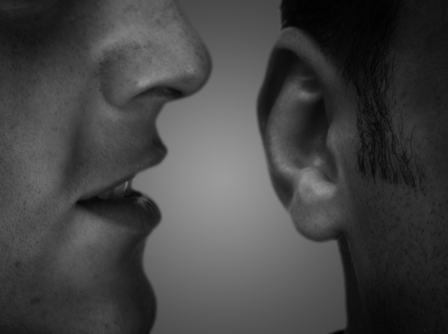
Learning to Listen: The Voice

Benedict Auer wrote this little piece:

“In the film Dead Poets Society, a student pretends to get a phone call during morning assembly.  When the phone rings, he answers it and tells the headmaster that it is God calling.  I have spent the majority of my life waiting for that ring, putting my life on hold, sitting through sleepless nights waiting, as if for Godot, but I only get wrong numbers or solicitors.  Each ring I anticipate a divine voice, hoping beyond hope that this time it is God, but then it is a lonely voice or a distraught student, and again I missed God.

Or did I?

I wonder if maybe I have heard from God but just haven’t recognised the voice.”

Or as Meister Eckhart puts it:

God is always at home.  It is we who have gone out for a walk.”

Learning to Listen: Silence

An unknown writer shared this about the power that silence and solitude can have within spiritual life:

“There is exterior silence and interior silence. The monastery is, or should be, a place of at least relative silence in the sense of the absence of unnecessary noise and agitated movement. We are less assaulted by harsh sounds; rather we are soothed by the mostly harmonious sounds of nature, and bells and our Gregorian chant. This pacifies our sensibility and refines it. A heightened awareness is a common experience in solitude and affects all the senses, for they are all linked together.

In silence we are more vividly aware of colour, and perfume and touch, because we are more present to ourselves. And little by little, we become attuned to the breathing spaces of silence between the sounds, as it were, like an underlying melody, not exactly ‘heard’, and yet somehow perceived, something that can take the character of a presence.

Silence begets an attitude of listening. The artist, the philosopher, the praying person may perceive or, at least, express in different words diverse aspects of this reality, but all have need of silence, receptivity, and awareness.”

Unnecessary noise and agitated movement… if only this stuff were relevant to “here and now”, eh?!

Becoming attuned to the “breathing spaces of silence between the sounds”… LOVE that phrase. I’ve heard that the difference between surviving or perishing in a pile of rubble (earthquake or whatever) is often whether a victim has access to a “breathing space” or not. Not hard to run with that illustration, is it?

Receptivity and awareness… I always need more of both. Might some silent solitude be in order?

Learning to Listen: Stability

This powerful bit comes from Joan Chittister. If we’re free to choose our spiritual mentors, I use one of my top picks to select her.

“When the monastic makes a vow of stability it is a vow designed to still the wandering heart. There comes a time in life when everyone else’s family seems to have been better than my own. There comes a moment when having everything seems to be the only way to squeeze even a little out of life. There comes a day when this job, this home, this town, this family all seem irritating and deficient beyond the bearable. There comes a period in life when I regret every major decision I’ve ever made. That is precisely the time when the spirituality of stability offers its greatest gift.

Stability enables me to outlast the dark, cold places of life until the thaw comes and I can see new life in this uninhabitable place again.

But for that to happen I must learn to wait through the winters of my life.

THOSE moments… I know them.

Winters of life… I’ve had those.

Stability… I seek that.

Fight

A Catholic priest from Chicago was credited with these words:

“Have we as a nation become so corrupted that as long as we get what we want, as long as times are good and the money rolls in, that we don’t care what the hell goes on?”

I certainly hope not.

Fight the good fight, children of light. Shine and blaze forth on behalf of life and love and goodness.

Habits

My morning reading introduced me to a man named William James. On the topic of “How to Change One’s Habits”, he offered a few great reflections on the power of these tendencies and patterns that we create:

“Could the young but realize how soon they will become mere walking bundles of habits, they would give more heed to their conduct while in the plastic state. We are spinning our own fates, good or evil, and never to be undone…

The drunken Rip van Winkle, in Jefferson’s play, excuses himself for every fresh dereliction by saying, ‘I won’t count this time!’ Well! He may not count it, and a kind Heaven may not count it,; but it is being counted none the less. Down among his nerve-cells and fibres the molecules are counting it, registering it, and storing it up to be used against him when the next temptation comes.”